For around a week I have been camping. Alternating my time between weathering a storm in a windswept field and ‘swimming’ in the Pembrokeshire sea. I say ‘swimming’ since the waves are strong and frequent enough to push one around. Hence the reason I found myself in Haverfordwest/Hwlffordd.
Pembrokeshire is home to a smattering of artsy towns, each replete with plenty of galleries. On another occasion, I may write about St. Davids, or the nearby Solva. Both pleasant alternatives to St. Ives. However, the focus of today’s review is The Riverside, Haverfordwest. This focus is partly down to my phone having enough battery life to take photos.
Furnished by The National Library Wales, The Riverside is a café-library-gallery complex situated, unsurprisingly, on the River Cleddau. At the time of my visit, the gallery is showing two exhibitions: ‘Pembrokeshire: Then and Now’, and ‘CYFOES: Contemporary Welsh Art’
A permanent exhibition, ‘Pembrokeshire: Then and Now’ is a sophisticated exhibition exploring a specifically Pembrokeshire identity within a broader Welsh identity, and makes good use of abstract landscapes, artists ephemera, and photography to isolate something quite special and wild about the natural and lived landscape around Haverfordwest.

Text is consistently Welsh first, English second. Along the first wall are a selection of photographs, black and white, spanning several decades. Each photographer is given a single framed work, all hung at a comfortable height, level with one another. There is no sequentiality or chronology. Instead we are allowed to see people living and existing – not quite outside of time but certainly experiencing a different flow of history. The photographs themselves are brilliant. A portrait of landlady screams character.
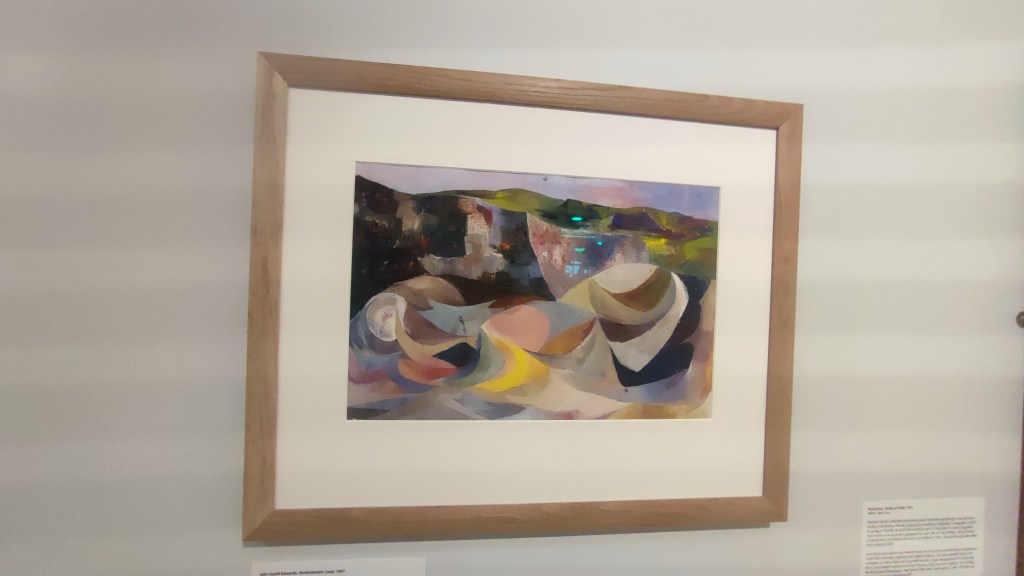
Around the corner we see a run of works responding to, or depicting, the natural landscape – mostly cliff faces. Their angular beauty is expressed in unnatural but inherently understandable colours. I am a big fan of John Uzzell Edward’s Pembrokeshire Coast (1967). There is something critically recognisable about these images, especially having spent much of the last week around these self-same cliffs.
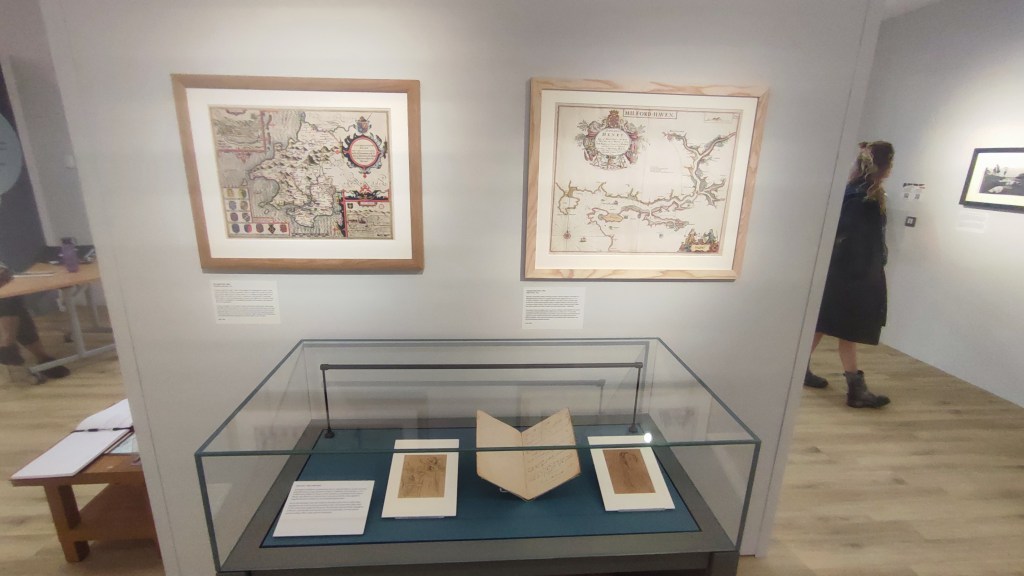
A counterpoint, opposite, comes in the form of a pair of maps. A historical visual understanding of Pembrokeshire. Ephemera, artists sketchbooks, are included in hip height cabinets, allowing a private view into the patterns of the artists.
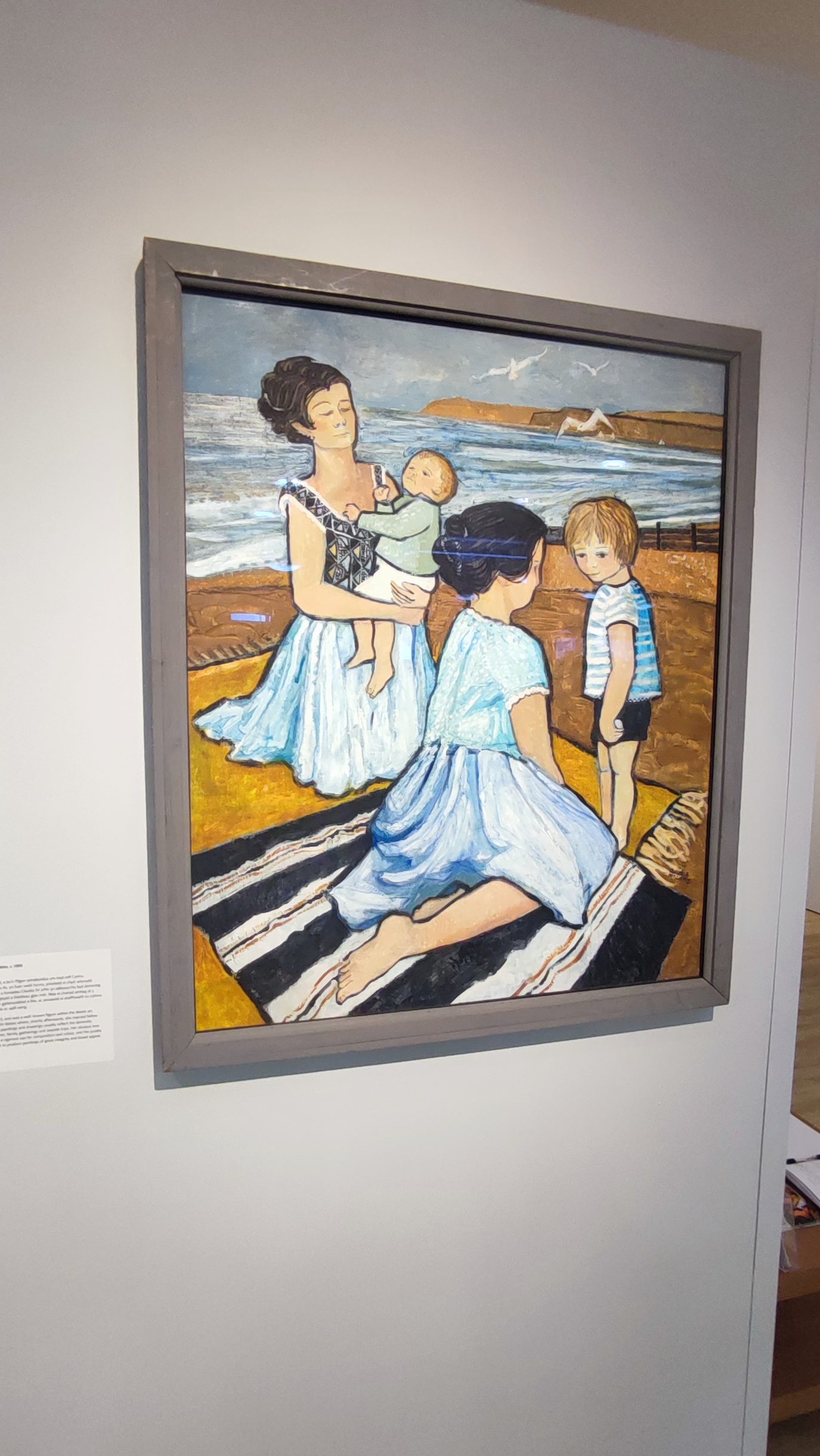
The key work, at the entrance of the gallery is Claudia William’s Mothers and Children (c. 1995). It is a characterful and somewhat dated work, feeling like it should be from the late 19th C. An interesting line of text describes her work as ‘paintings of great integrity and broad appeal’. There is something self-effacing about this wording, as if the engageability of the work diminishes its artistic merit. I disagree. It is a brilliant painting and well deserving of this spotlight.
The entire gallery seems to construct and understand a Pembrokeshire identity. It makes no moves to de-construct or investigate it, only to demonstrate its presence and hint at its defining features. I see this as a bold and respectable move. The exhibition is about constructing a visual culture and identity for Pembrokeshire. Any move to deconstruct would be counter-productive. As such, I highly rate both the individual works and the overall curatorial choices on display in this exhibition.
In the second room we see ‘CYFOES: Celf Cymru Heddiw’ / ‘CYFOES: Contemporary Welsh Art’. This is an effort to display work from the past decade, intended to highlight ‘our recent efforts to expand and enrich the collection to reflect experiences from all communities and backgrounds in Wales’. An admirable goal leading to the display of some excellent works. Yet, lacking a more precise focus than simply displaying recent Welsh artists, the overall curation lacks bite.

Each of the works are brilliant. The entryway displays Seren Morgan Jones’ Blue Gloves Orange Chair, (2016). A neatly flattened yet highly expressive work with masterful painterly technique. Many mediums are present, works are in ink, are woven, are on video, sculpture, watercolour, etc.

The great majority of works are both by Welsh Artists and explore Wales and Welsh identity. Some works are grouped around exploration of the myth of the magician Gwydion and his creation Blodeuwedd. Others replicate or understand the landscape, or the people within it. Some works are explicitly of Welsh people underrepresented in traditional art. Adeola Dewis’ HorseHead, (2022) pulls from Gilbert & George’s playbook in order to draw comparisons between Jamaican traditions, jonkonnu, and the Welsh Mari Lwyd. Here the exhibition is brilliant. Contemporary Welsh Art, by Contemporary Welsh Artists, exploring Contemporary Welsh Identity.
However, certain works have no stake in Welshness, beyond the Welshness of their creators. One work responds to a passage of Shakespeare. Another to Covid-19. In these moments, the exhibition loses clarity. It is still Contemporary Welsh Artists and Contemporary Welsh Art, but it lacks the important raison d’etre. It transforms the exhibition into a very high-quality grad show.
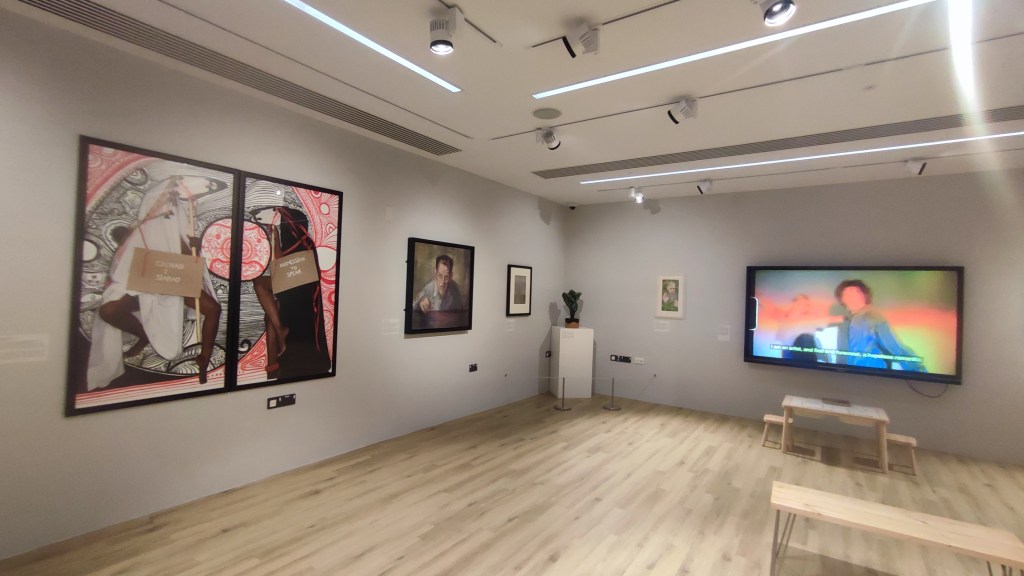
By centring the exhibition on Contemporary Welsh Art rather than Contemporary Welsh Identity, The Riverside misses a trick to focus and sharpen the show. All the works are individually excellent. The artists displayed are certainly ones to watch. However, they were so close to building an incredible counterpoint to the neighbouring gallery on Pembrokeshire. Artists in Wales responding to Welshness is a rich and potent resource. Yet, here, only 80% engages in Welsh Identity. By diluting this focus, the exhibition becomes instead a showcase of impressive work, less than the sum of its parts.

That said, the calibre of the art in both exhibitions is excellent. So, if you ever find yourself in Haverfordwest, or anywhere in Pembrokeshire for that matter, I highly recommend a detour to The Riverside Gallery.

 Caleb
Caleb 
Leave a comment