This review comes with a series of caveats. As I write this, I am sitting at the front desk of Castlefield Gallery, working a voluntary shift. Moreover, I helped with the install – constructing frames and cataloguing artworks – and worked the non-alcoholic bar during the opening. Hence, my appreciation of this exhibition may be clouded by the time I have already spent around it and my respect for Castlefield Gallery, what they stand for and what they do.
Yet, were I to have encountered this exhibition for the first time, I believe I would have a similar opinion.
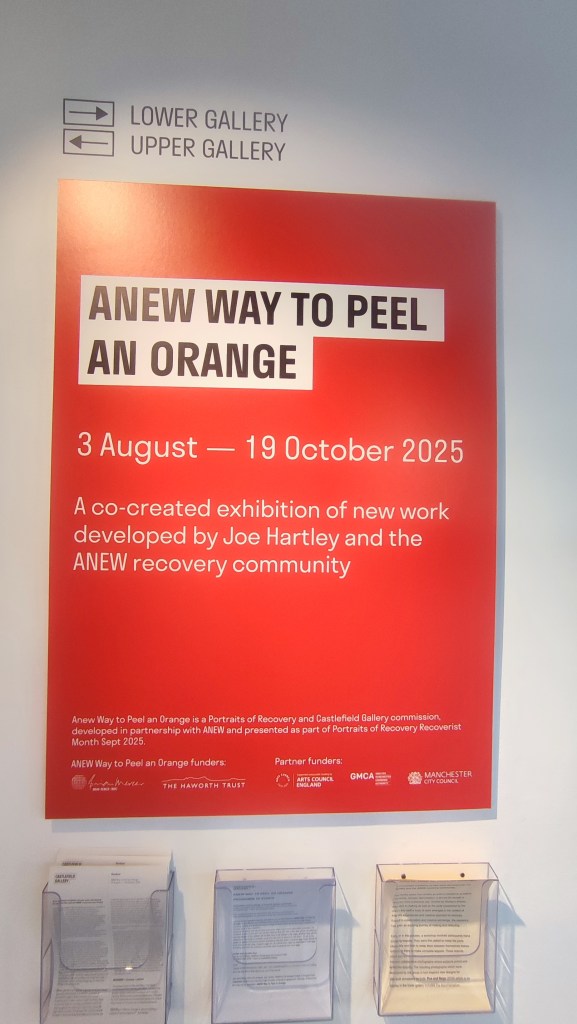
‘ANEW Way To Peel An Orange’ is co-curated by Joe Hartley and the ANEW recovery community. It, much like Recoverist Curators, has been commissioned by Portraits of Recovery, through the CHAORDIC programme. It too is framed around the Recoverist – ‘recovery + activist’.
Unlike Recoverist Curators, this exhibition is made up of works created over a five-month residency. This has produced photography, ceramics, and even a garden. Before you enter the Gallery, you will pass through the Castlefield Gallery Garden, a set of flowerbeds containing ever-so slightly unusual plants. Joe, himself, leads ‘Evening Gardening Club’, and it is nice to see the overlap between this project and his other work.
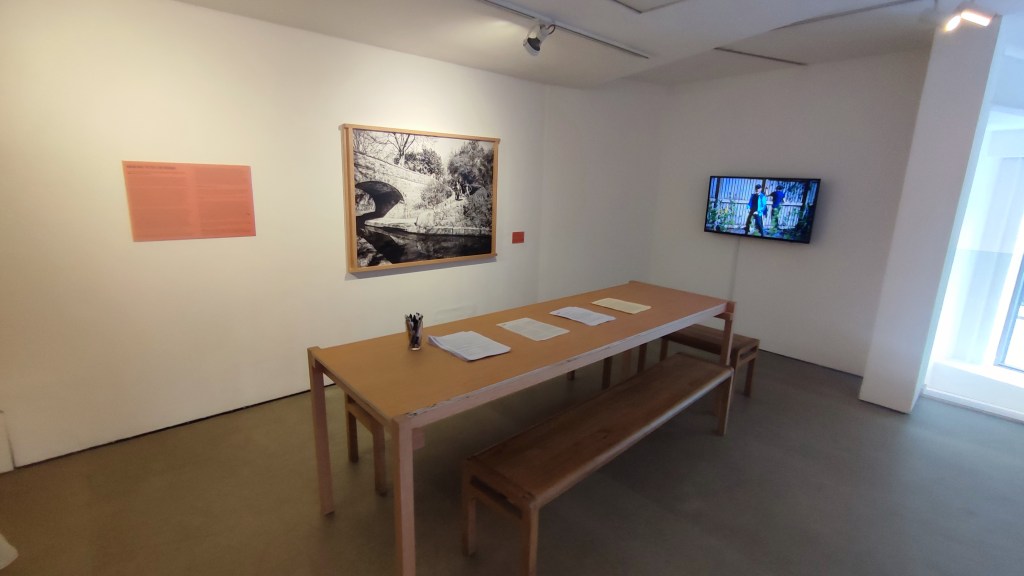
Within the upper gallery, an information panel rather comprehensively explains the multi-faceted process, leading up to the exhibition. It is unavoidably dense, but not unfairly so. It is consistently informative and perfectly contextualises both the artworks and the people who have made them. On occasion, the text offers interpretations of aspects of the exhibition. The thematic resonance of the use of horsetail (Equisetum arvense) is spelled out. Normally I would find this off-putting. However, explaining the use of horsetail as a natural ceramic glaze – due to its high silicon content – while it is normally considered an invasive species has specific, justifiable, and powerful resonance with the process of being in recovery.
‘The horsetail glaze is exemplary of the potential that can be found when we challenge our negative assumptions of people and things’
‘All the works in the exhibition are informed by lived experience and underpinned by the critical importance of recovery as a collective process’
In conversation with Joe, I learnt about the process of the project. The artworks have been created by a continually changing team. First, ceramics. Then, when these ceramics didn’t turn out right, photography. The Recoverists positioning themselves as teapots, re-imagining themselves, shot as silhouettes. A different group then turned these silhouettes into the human-form teapots seen in the exhibition. Evidence from all these steps is present within the gallery. It is admirably transparent – adding to the personality and personhood behind it.


The first room of the lower gallery is home to a tall horsetail mural. Again, the importance of collaboration shines through the work, which is at once cohesive, and very aware of individual contribution. Hiding in the space, furniture made by the team. Joe said that the challenge was to use every single bit of wood – no cut offs.
The entire lower gallery is very light and airy. Nothing feels cramped, the space is very navigable.
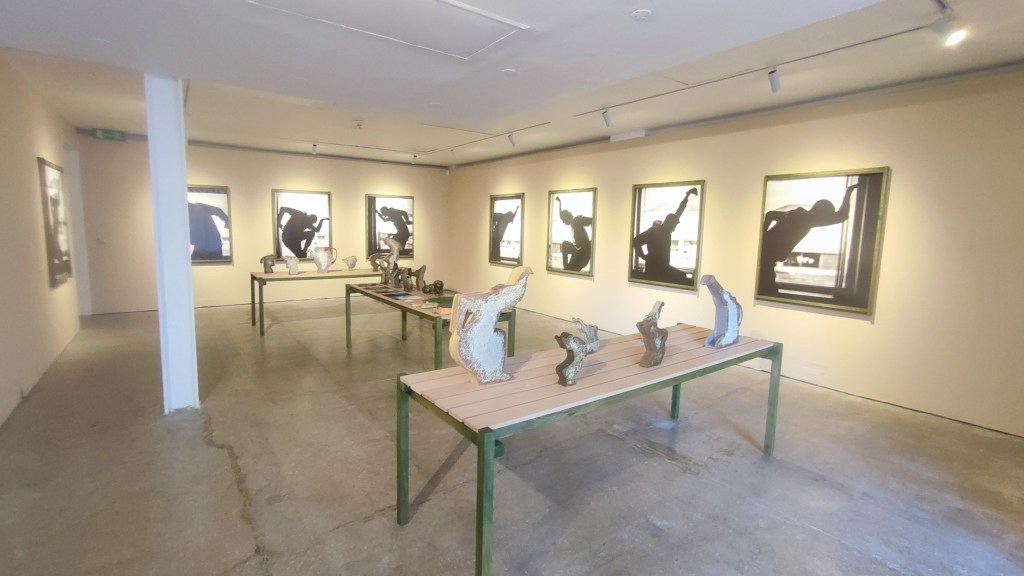
Here, the exhibition very clearly comes together. Large prints of silhouetted photos line the wall, spaced out and hung at the same height. In the centre, ceramics sit on workbenches. They are stood upright. Direct parallels between the photographs and the teapots are stunningly clear.

A metal cage features a video screen showing footage of some chickens, also part of the project. It provides a pleasant soundscape, mixed in with short clips of the artists. I’m a sucker for birdsong at the best of times. Combined with the bright, sunny gallery space, it creates a lovely space.

The game of visual identification is a lot of fun. Teapots can be matched to their silhouette, really drawing together all aspects of the project. On the central table, photos are set out documenting the project. There is little text here as the intent and result is quite self-evident.

The horsetail glaze creates delicate, unpredictable textures. The imperfections and irregularities of the ceramic works make each one worth spending time with.

Back upstairs is a small pop-up shop selling a handful of these ceramic teapots, along with photography prints, and very charming metal works shaped like orange peel. Originally designed as coat hooks, these peels are an absolute steal at £24. A series of events and workshops run alongside this exhibition, which is all the more reason to pop in yourself and see it.
Again, being around the works, and having talked at length with the artist in residence, I am biased. However, every space within the gallery – including outside – is used incredibly and effortlessly. The exhibition, resulting from a brilliant project, is thoughtful, playful, human, and aesthetically and thematically solid. No notes.
ANEW Way To Peel An Orange is on show at Castlefield Gallery between 3 August – 19 October, and is free to enter.

 Caleb
Caleb 
Leave a comment