Tucked away on the second story of an unassuming office block in Stockport is one of the most remarkable and exciting art spaces I have ever had the chance to encounter. PINK, a gallery, artist studios, and events space, displays both curatorial integrity and a true passion for engaging, supporting, and platforming ambitious new artists.
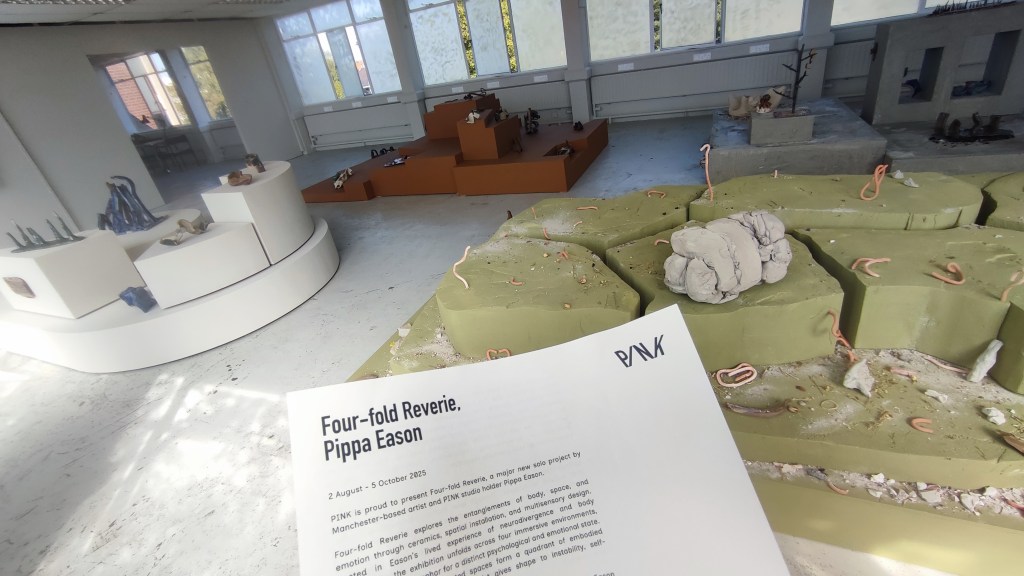
Four-fold Reverie – a solo project by Pippa Eason – showcases masterful and exploratory ceramics works, backed up by a genuine integrity of ideas. The show is open on weekends between 2-6pm, until 5 October. I highly recommend getting here by any means necessary.
Getting into the building is, at first, a bit daunting. There’s no ‘stumbling across’ this space. Texting a number on an indistinct piece of paper at the buildings entrance will summon someone to let you in. The faux-exclusivity this gives the gallery is a shame and will have an impact on footfall. Yet, my text is immediately answered and Nick Booton – artist and studio-holder – brings me upstairs.
In the sweltering weather, PINK is cool and calm. Nick reads a book behind a small desk. Sunlight filters through frosted windows onto white concrete floors. It is airy, light, and welcoming. I am given a piece of accompanying text and told that – if I wanted – there is a set of headphones available to listen to this text narrated.
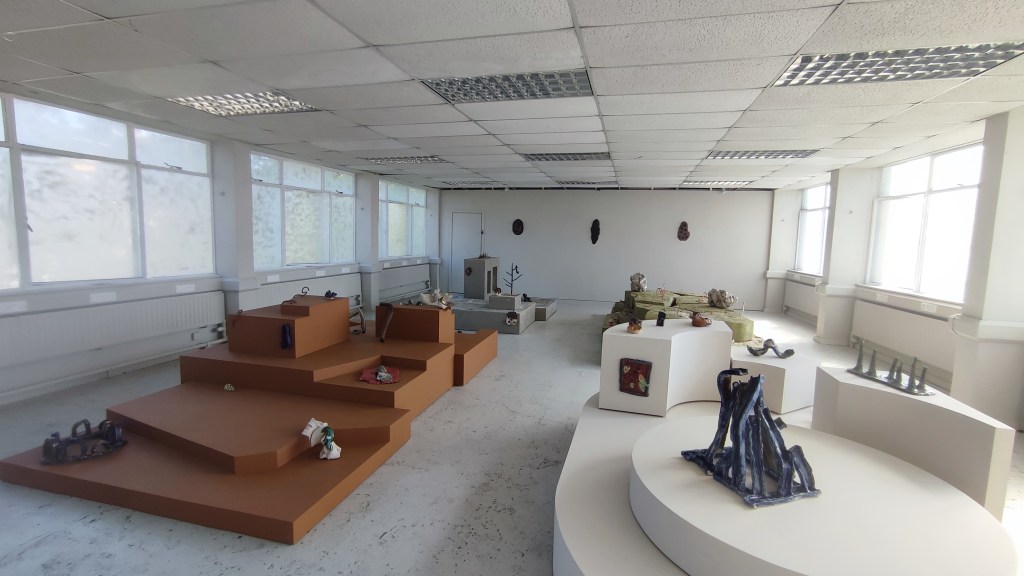
Moving past the foyer into the exhibition itself, it is stunning. Having been busy (working at Castlefield Gallery) during the opening, this is my first time encountering Easton’s work. I am glad I am alone, as I imagine it would be a very different experience in a crowd. Nick tells me there have been repeat visitors, people from the opening night returning to better reflect on the works.
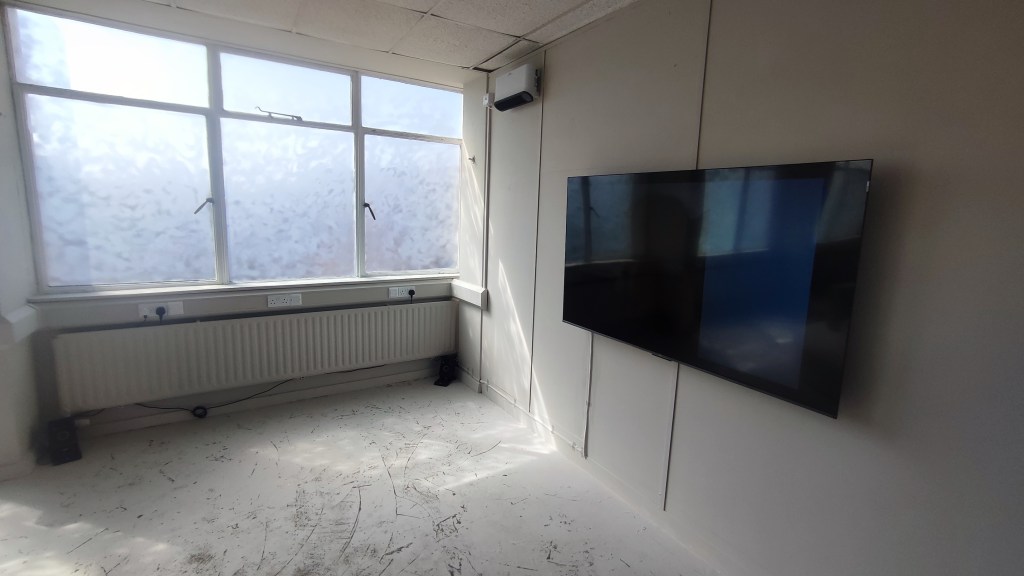
Bracketing, for a second, the ceramics, I turn to my right to watch the accompanying film – created in collaboration with Nick Booton – and listen to a full cycle of the sound piece by Jia Lee. Speakers have been placed both by the screen, and within the staging materials, creating a holistic soundscape. Utterly transformative.
The soundscape, gently rising notes, takes a subtle shift to more industrial, sinister sounds, changing my response to the film and ceramics. Accompanying images of urban decay and natural landscapes walk the well-trodden yet sophisticated and engaging path of the haunted dream sequence. Notably, the length of film and music doesn’t match, meaning any pairing of image and sound is borderline unique.
The room is gorgeous. Four stations create distinct spaces, in conversation with one another. Eason uses ceramics to explore neurodivergence, embodiment, dysmorphia, and instability. Referring to the text, each space explores a difference facet of being and feeling. Yet, forms and shapes are shared between these spaces. While they are sequenced numerically, I feel that the exhibition invites a far more non-linear route to exploration.
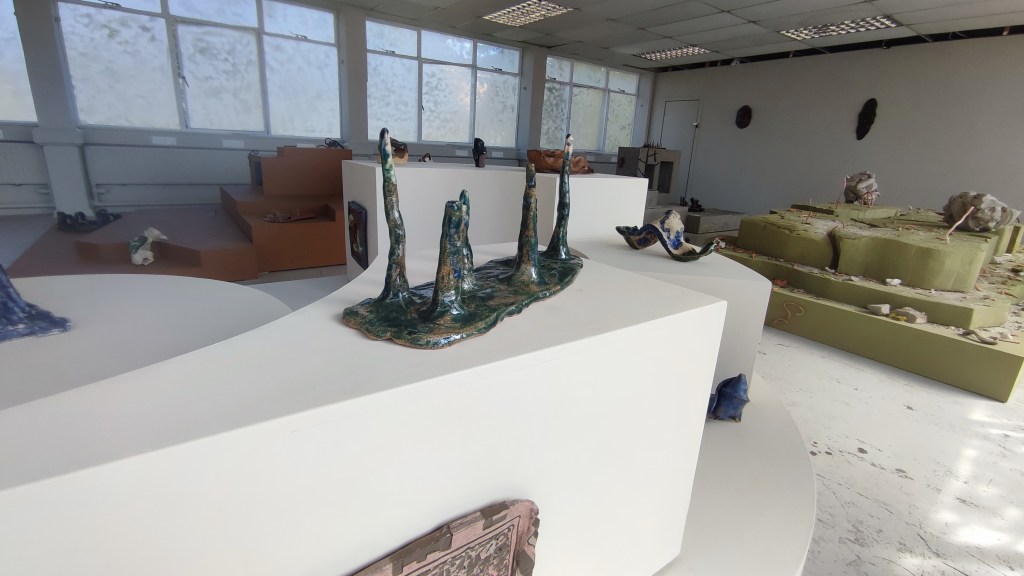
I am first drawn to what I learn to be the third space. Beautiful works, bordering between natural and artificial, rest on a perfectly white, curved display. This area is described as slick, refined, and soft. ‘The outer shell that is expected’. For me to actively approach here first is telling, that I am conditioned by the same forces of expectations. This is something I want to reflect on further in my own time.
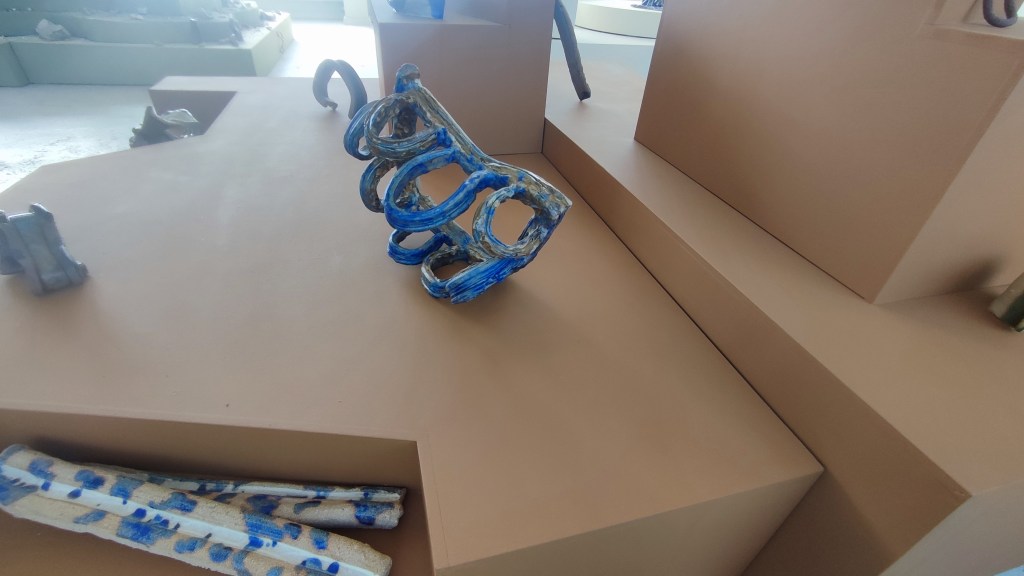
Realising the integrity of the drive behind the pieces, I change tack and approach the first space. The concepts, as they are told both through text and art, are incredibly well articulated. There is no sense of disconnect between the writing and the sculptures. Overlap between thematic groupings creates a perfect sense of flow and rhythm, a swell of the tide that carries the visitor throughout the room. It would be interesting to learn whether each artwork was created with a specific space in mind, or, through the process of creating, fell retroactively into a space.
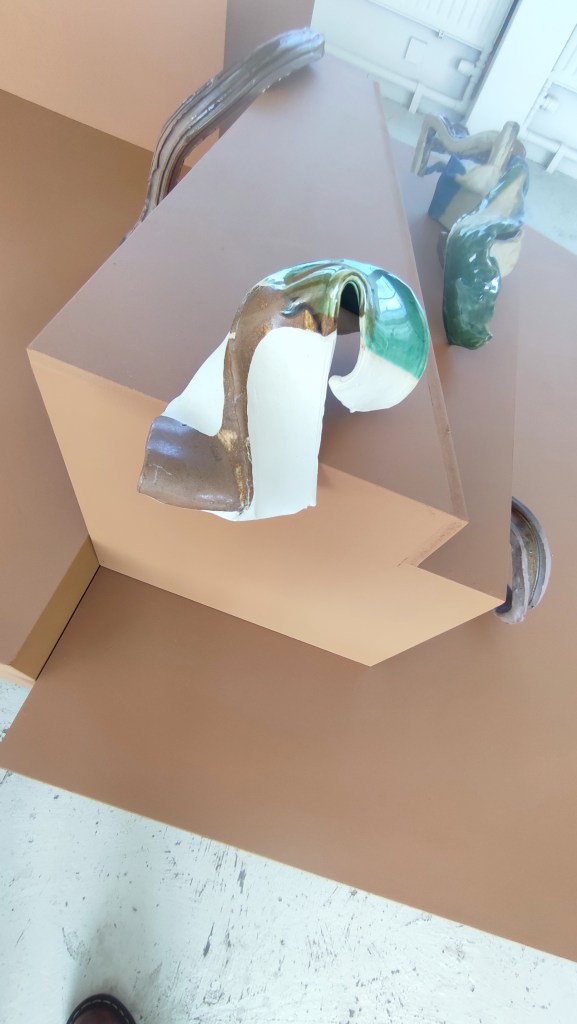
The first space holds in tension linearity and circularity. The beginning of a journey, a sense of conflict and opposition.
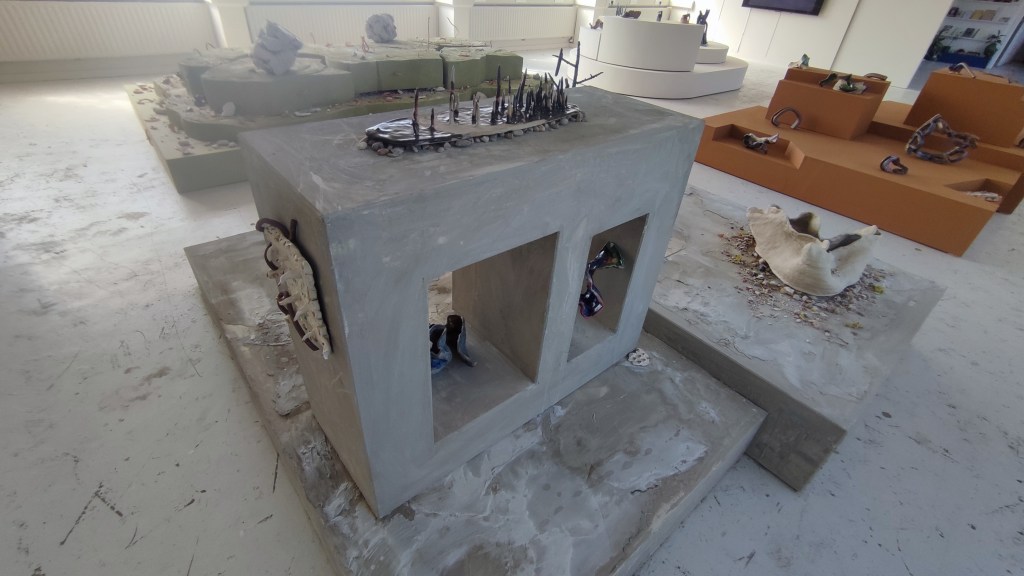
The second space is deliberately unrefined. It explores the feeling of being watched, being perceived. It is rough and textured and raw and industrial.
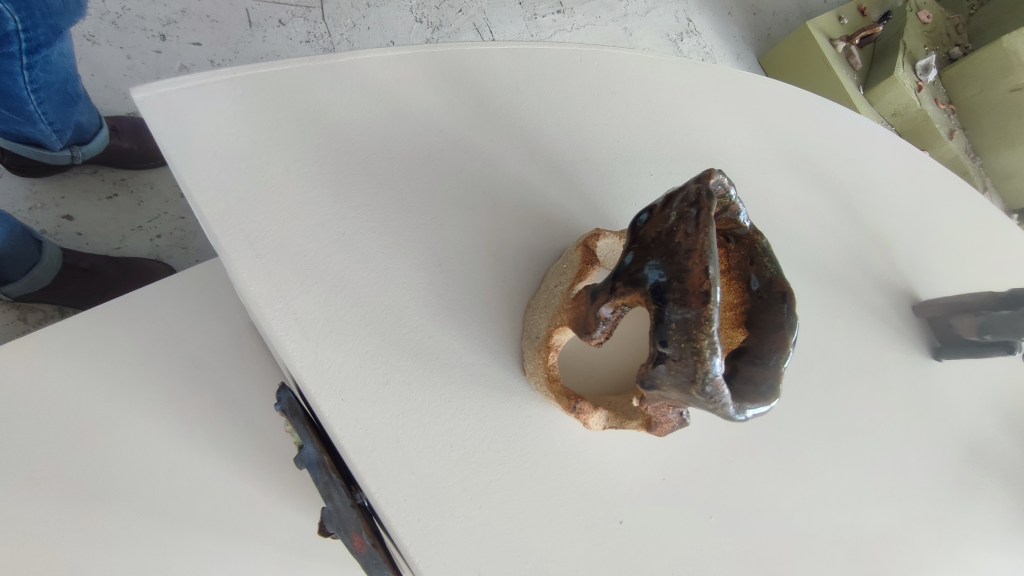
The third space is the aforementioned place of pretence. It is conformist, potentially commercial and aesthetically pleasing.
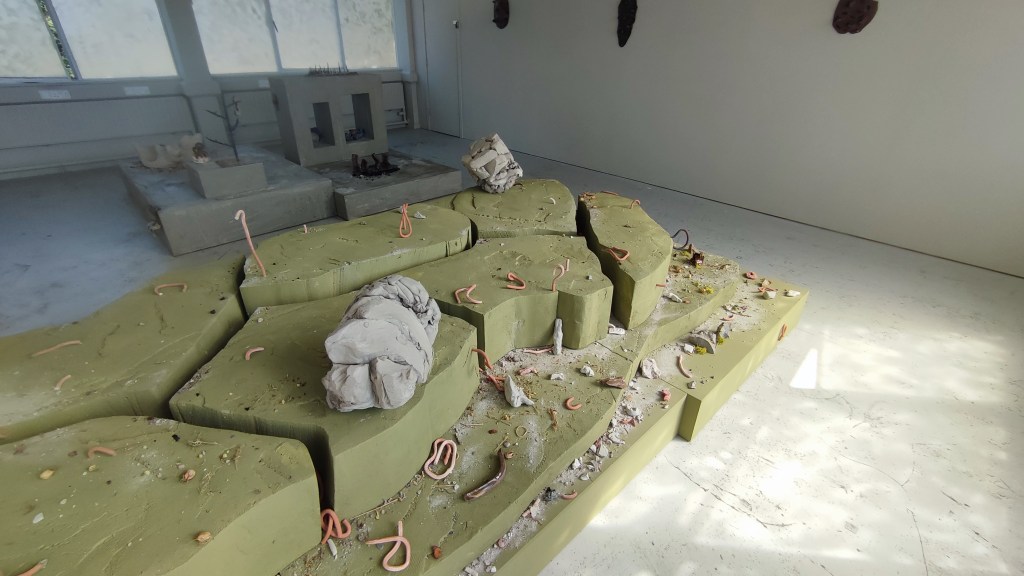
The fourth space is by far the most interesting. It is a space of freedom, non-conformity and ‘an ability to be raw and expressive without judgement or fear’. It unveils the process; strange shards of brick and rock are scattered through this artificial moss-scape. It is a willing revocation of an expected system or outcome. It speaks strongly to the overarching themes of neurodiversity and embodiment. It is, in some sense, uncomfortable, unfinished, un-aesthetic. In which lies the joy and freedom.
Is this a conclusion? Is this fourth space the synthesis of a dialectic of modes of being? Or are all spaces interwoven? A cycle of states that ebb and flow. Different intensities vibrating across the body without organs that is life.
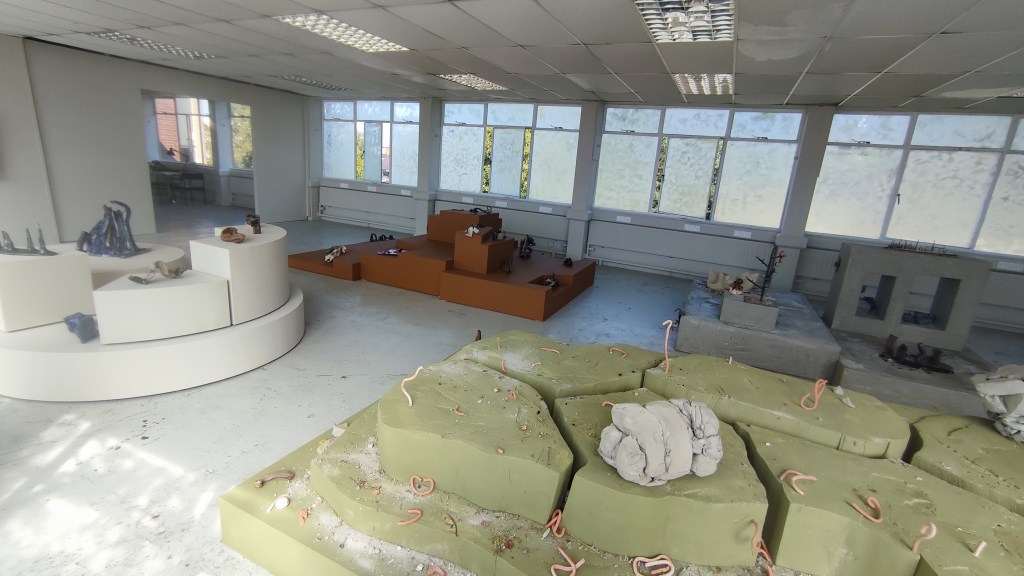
The suggested sequentiality is the only aspect that feels forced. For me, this is a space of constant renegotiation and reconstruction, of exploration and becoming. As the soundscape shifts from dreamlike to unsettling, I am prompted to return to each artwork, re-considering my relationship to them, and my relationship with myself.
This is hands down the best exhibition I have written about so far. It is a personal place of reflection built on a firm foundation of well-articulated and expressed ideas. Eason’s artworks are themselves impressive, yet the exhibition is more than the sum of its parts. I am highly excited to keep an eye on the comings and goings at PINK.
Four-fold Reverie is exhibiting at PINK between August 2 – October 5. It is open to the public between 2-6 on Saturdays and Sundays.

 Caleb
Caleb 
Leave a comment