A stop by the Whitworth feels restorative. Doubly so, as the focus of today’s review is Trees. As expressed in my review of Giuseppe Penone, I find nature – in person or in art – pretty key to living. A moment of calm, of grounding.

Performing Trees takes over the space from Malgorzata Mirga-Tas. Rather than a focus on a singular artist, this exhibition focuses on a singular subject. Trees, their connection with artists, and the art that captures them.
It is a simple brief, yet compelling. The multifaceted form of the tree, and its many-directional symbolism, has enough depth to enable a tranquil, substantial, and at times insightful exhibition.
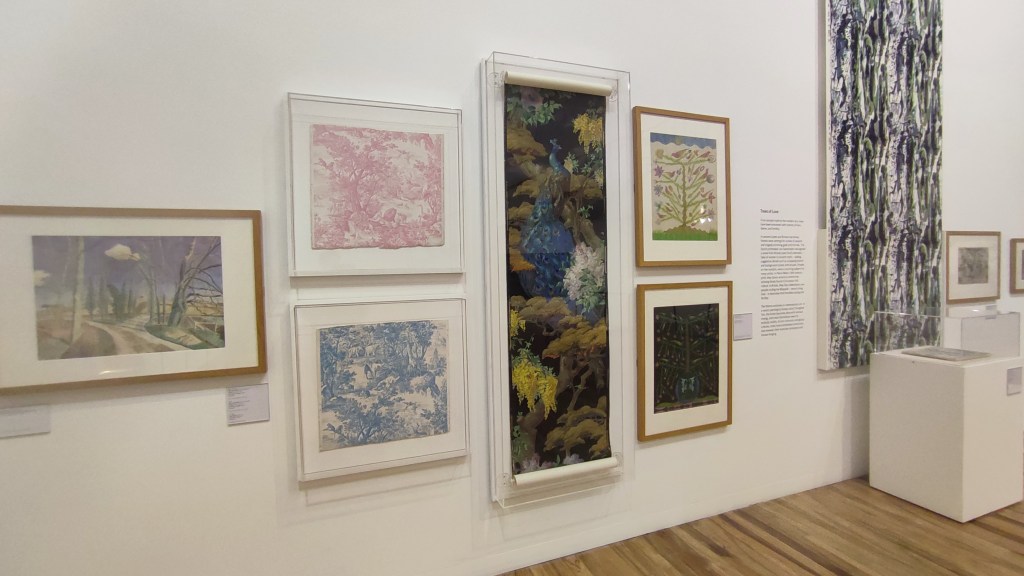
The exhibition is organised thematically. Dense clusters of artworks correspond to wall text. These moments of text introduce a theme and draw connections between the relevant artists and artworks. The driving thesis is that the tree is key within the human imaginary – a notion I agree with.
Travelling Clockwise, I encounter Trees of Life. An introductory passage brings ideas of Eden and sacred wilderness to the surface. A reference to the ‘noble savage’ myth passes by uncritically. I expected this to be explained further, especially considering The Whitworth’s commitment to social justice. Yet, the concept is presented and not dwelt on.

Trees of Love appear next. Imagery of fertility, from May-Day rituals to fruiting boughs. Interestingly, the most striking work in this cluster – Dorothy Carr’s Oak – isn’t mentioned in text. Wall filler, and, to me, one of the most visually engaging works on display.

A larger cluster concerns Trees of Invention. Here, an interesting theme emerges: the presence of trees in innovative artworks. The claim is that when new mediums are tested, it is quite likely that an artist will depict a tree. The culmination of this idea is found in Anthony Hill’s Five Regions Relief, an abstract, wall hanging sculpture. The exhibition argues that his use of wood as a material grounds his abstraction. I feel that this is a reach. In addition, the lack of ‘tree as subject’ dilutes the exhibition as a whole.

During Conflict. Trees as indicators of hardship. The images in this section are beautiful, but again, the grouping theme seems rather light.
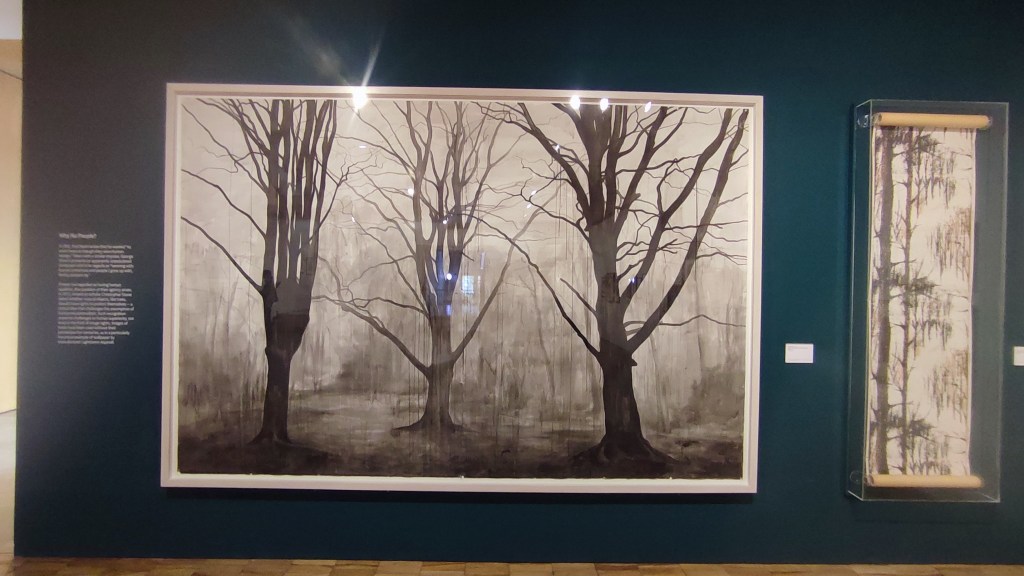
On the far wall we see an unpopulated landscape courtesy of George Shaw. This section, comprised of two images of only trees, no humans, presents an interesting provocation. The relationship between trees and their human qualities. Are we anthropomorphising these aspects of nature? Is this problematic? Text reads “images of trees have been used without their permission for centuries”. The consideration of the agency of trees and their relation to the art which depicts them is perhaps the most substantial idea found within this exhibition.
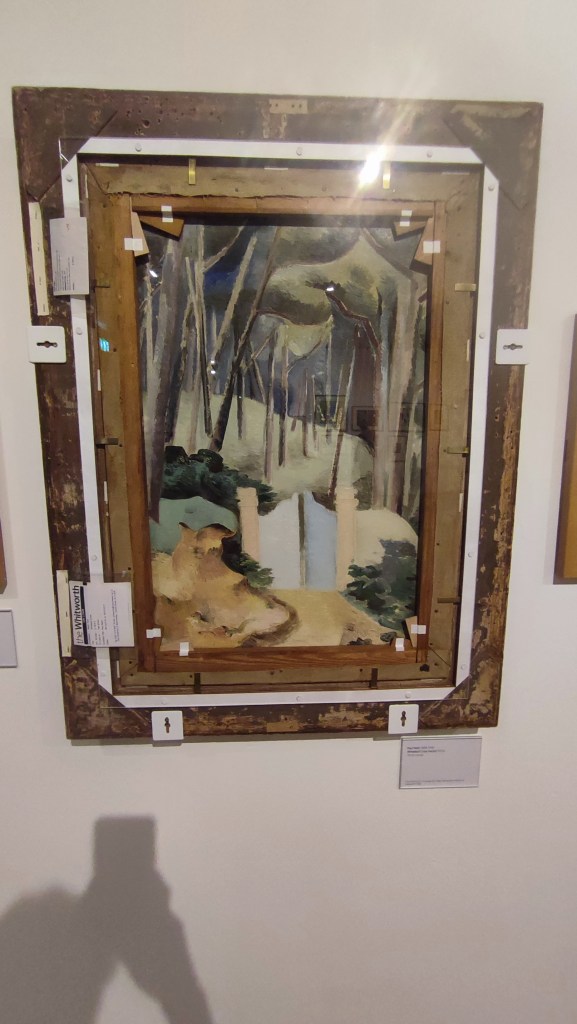
Reminding me of Site Seers at the Saul Hay Gallery is a section on constructed landscapes. Achieving the perfect composition for imagined landscapes through the use of trees. Here, we find perhaps the most intriguing and exciting artwork. A painting by Paul Nash discovered on the reverse of Whiteleaf Cross. A recent discovery, the presentation of art set into the underside of its frame is quite compelling.
A slight section covers the notion of being One with Trees, a fly by of interconnectivity and links with philosophy.
The award for the best named section goes to ‘dreaminess of liberation’, a quote taken from author Sumana Roy. This section deals again with mythology, specifically with the repeated image of transformation into/from a tree. Dryadic imagery can be found throughout the exhibition but is at its most focussed here. Myself feeling in the midst of a transitory period in my life, I was quite taken by the artwork on display.

And finally, the End of The Road. An almost mandatory section detailing art, nature, and finality, with the presence of the Evergreen Tree as an indicator of immortality. It is a satisfying note to end on.
To summarise, the calibre of artwork on display is excellent, as is to be expected from The Whitworth. While the overarching theme could be seen as superficial, oversimplistic, the way in which it is unpicked, disassembled and explored has pointed thought behind it. As a longstanding exhibition – on for 18 months – I hope that a series of events is held to accompany this exhibition, lest it feel like a placeholder. Personally, I could have done with more depth, but the consideration on display was more than I initially expected.
Performing Trees is on display at The Whitworth between Sept 30 2025 – April 4 2027 and is free of charge.

 Caleb
Caleb 
Leave a comment