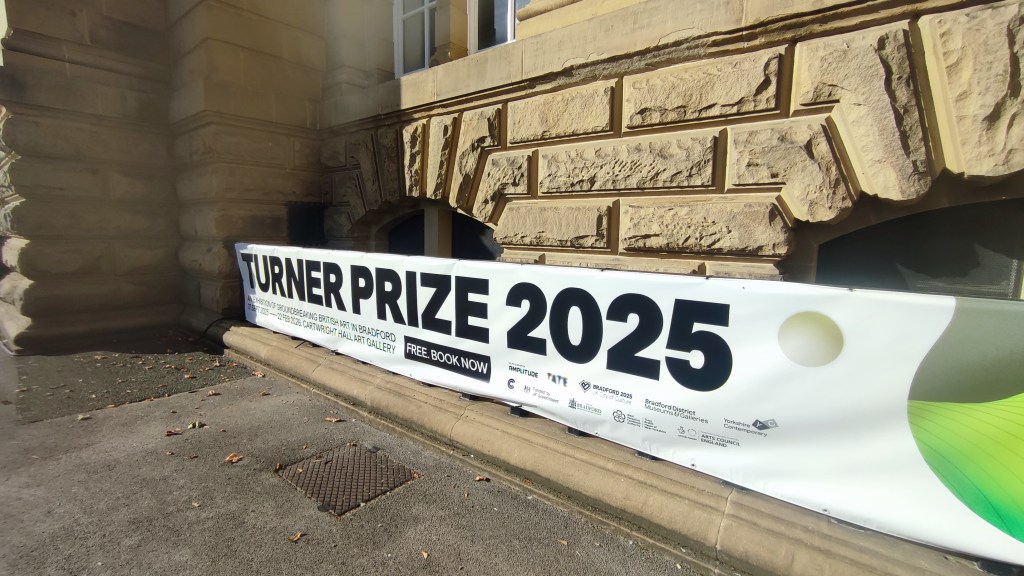
The whole of Manchester is sleeping under a blanket of fog. It is only midway through the train journey that it lifts. I am travelling to Bradford – 2025’s City of Culture – to visit Cartwright Hall, this year’s venue for the Turner Prize exhibition.
I’m going to make a bold claim. My favourite to win is Mohammed Sami. The prize is awarded on December 9th, so let’s see how my prediction holds. I will explore why Sami is my favourite in the second part of this review
Having read a handful of reviews prior to my visit, I had a sense of what to expect. A prize as conventional as it is contentious, I had heard that this year was rather tame. Safe. I had come to assess the art, and the artists, for myself.
In order to give the time of day to both the work of the artists, and to discuss the Turner Prize as a whole, this review will be split over multiple posts.

I arrive, the weather in Bradford crisp and clear, after a walk through Lister Park. The venue is beautiful. Cartwright Hall, a purpose-built art gallery from 1904, stands proud in the autumn sun. A prestigious looking building for a prestigious looking award. With the majority of sales made at my current job being prints of former Turner Prize winners, the award has weight – commercially, at the very least.
Tickets are free, but timed entry. I have arrived for 2pm. The cloak check is pleasant enough, and a food truck parked outside is quite tempting. My ticket is scanned and I’m in.
The entrance hall – replete with giftshop – is bustling. It is a weekend, and there is quite a broad cross-section of ages here. A few families with children, which I didn’t expect.

In front of me, framed by large airy windows, is an introductory room. Short videos – headphones attached to the wall with wires – play on repeat in front of a handful of seating sections. In the centre, an Anish Kapoor sculpture – a scaled down Chicago bean. In hindsight, I didn’t confirm whether this was, in fact, a Kapoor, but as a previous winner, his presence is unsurprising. The introductory text does a sufficient job at setting out the artists and specifying their reasons for selection. All artists are granted a plaque for acknowledgements.
The supplementary material – leaflet, map, banner, posters – are all beautifully designed. Gorgeous circles are cut out of everything – an almost sci-fi flare. It shows a level of attention to the overall exhibition that is laudatory.
Wrapping up my impression of the surrounding environment, I note a quiet room and a learning room, geared towards families with young children. Not only is it a nice addition, it is being used. In hindsight, the colourful, engaging, and initially light-hearted content of at least half of the exhibition does allow space for children to engage at an aesthetic and playful level.
I digress. On to the art.
Up first we find Rene Matic. Nominated for their solo exhibition ‘As Opposed To The Truth’ at CCA Berlin, Matic is given quite a small plot of land. With wooden floors evoking an attic gallery, Matic brings a small selection of materials, all couched in a repeating soundscape.
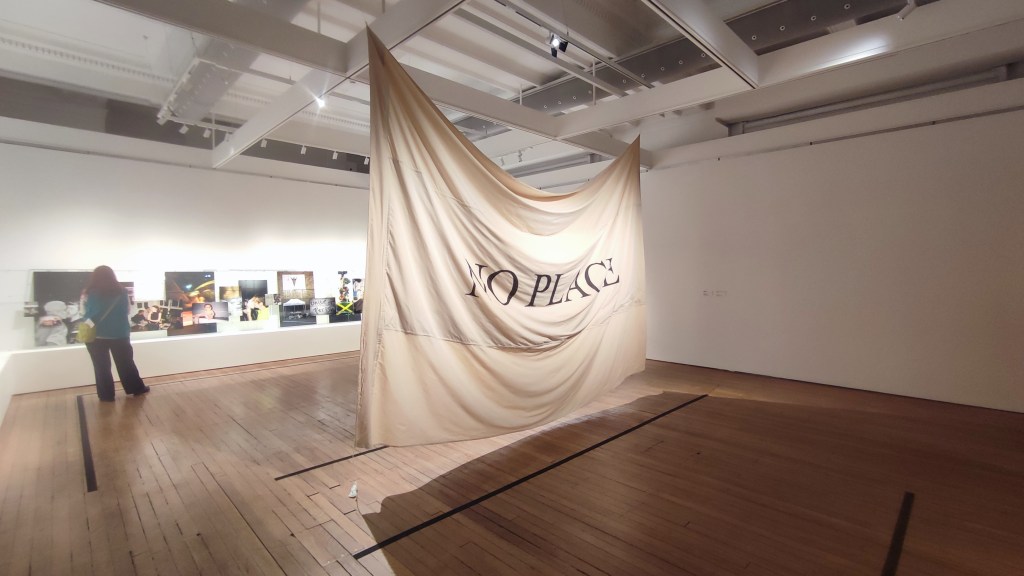
It is very – and I mean very – Adam Curtis. The use of potent and politically charged images accompanied by a rotating soundscape of often dissonant sounds amplifies the depth of both audio and visuals. Predominantly a photographer, their space is bisected by an attention grabbing and deceptively (?) simple banner. No Place / For Violence. Each half of the phrase dominates a separate side. It is the sort of work that a lot can be said about, yet, in isolation, says little. In the context of post-January 6, with the uptick of violence in America, the riots of Britain’s summer, it has potency. By putting the phrase loud and clear, it forces a viewer to step back and actually consider the content of the aphorism.

The exhibition is a snapshot of discontent. Of a fervent, politically charged, progressive, leftist rage – one which aligns with a lot of my beliefs. It is nothing I haven’t heard before, but it certainly cuts to the core of it. Bizarrely slowed down pop-culture – Charli XCX’s 365, and a choral Rhianna song – become disturbing rallying cries. They overlap with images of queer bodies, of protest, of intersecting identities, or joy, and of rage. I imagine, if you are predisposed to scoff at such political stances, then this exhibition would feel very 6th form. On some level it is. It is simple, but each simplicity builds into a multifaceted project of liberation and activism.
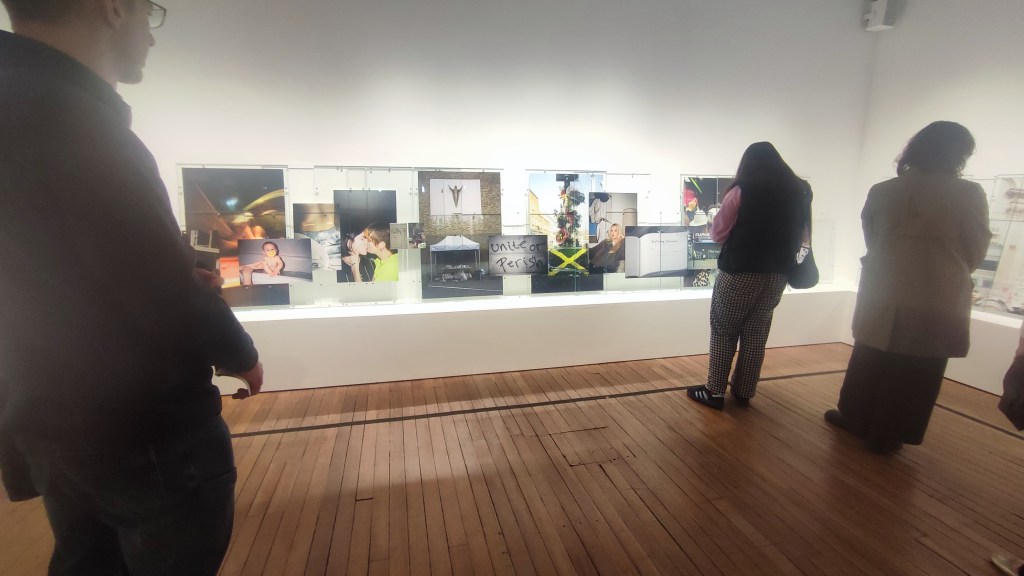
It is timely, but it is more of a rallying cry than a discussion generator. Decidedly uncomfortable – yet, if we’re uncomfortable, surely, we must do something about it. I am undecided whether it is potent or impotent.
Across the way we find Zadie Xa. Shimmering and reflective, her display is a barrage of colour, kept together by a cohesive focus on environmental issues.

We must wear covers on our shoes, lest we scratch the mirrored, golden floor.
One lady says she hopes Zadie wins, but in a way that feels as if she expects the jury to pick an artist with more pretence. That because she is aesthetically inviting and engaging, she is destined to lose. Perhaps. The prize has a way of perpetuating a certain form of ‘rebellion’ or ‘innovation’. Shock rather than comfort. Xa’s display feels like walking into a dreamscape.

And that is the point, I suppose. Concepts of spirituality, of interspecies communication, cultural tradition, stewardship run through her works. At the centre is the remarkable ‘Ghost’. A series of small bells hang in the form of a conch, creating substance and form through a number of isolated points. It is very tempting to reach out and brush the bells, to see what noises they conjure, to activate the ghost. Alas, this doesn’t seem to be the done thing.

In each corner, shells, suspended from the ceiling play sounds, sometimes voices, sometimes music, sometimes seascapes. At one point, the shells begin to converse with each other, taking turns to rattle of a poem. People are gathered in clusters underneath them, the sound directional and concentrated in points.
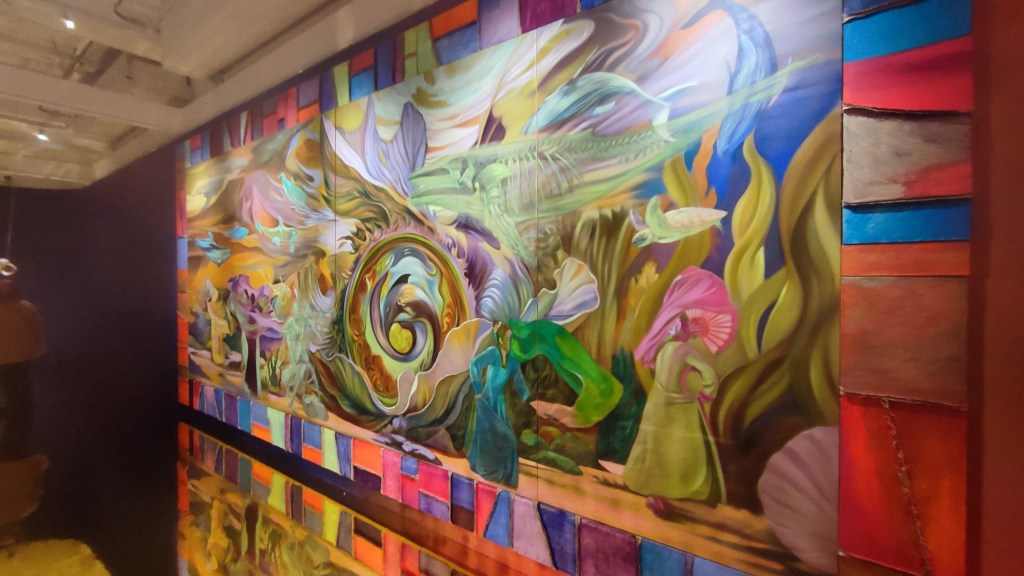
The entire exhibition is decidedly psychedelic. Reflections ripple on the ceiling. Each artwork, made of torn, painted and woven canvas, depicts dreamlike individuals and scenes. It is only the final piece – an eye at the centre of deep ocean colours – that sits apart. For me, it breaks the spell.

Standing for a while, I listen to the voices coming from the shells. They perform an exert of poetry. A rather disturbing, vivid, and affecting work on the climate disaster and the disappointment and fury of the planet in the face of human ineptitude and culpability. It is strong. The content of the words creates a fun dissonance with the floating and beautiful nature of the dreamscape. Out of all of the artists, I could easily see prints of Zadie’s work populating the walls of houses.
So far, my expectations are confirmed. That this year is a touch toothless. That the expected shock of the Turner Prize is absent, leaving a safe, and one could say irrelevant year. Nevertheless, the artists themselves are admirable. Zadie combines an aesthetic appeal with a genuine appeal for climate justice, while Rene taps into a very key social conscious with noted deftness.
Next time, I will discuss the upper gallery, Nnene Kalu and Mohammed Sami, and why Sami is my favourite to win.
Inconclusive/5

 Caleb
Caleb 
Leave a comment