There is a storm baring down on Manchester. Its winds whip up the rain, driving it into my eyes, into the fabric of my coat. An unobtrusive metal door, green paint threatening to peel off, sits recessed into an indistinct apartment building. It is ajar. Behind it, warm light. A rectangular frame holding the exhibition poster is barely visible past the gloom and spray of the rain as it hits the floor, hits the side of the building.

Pushing through the door, there is a burble of conversation. The antechamber, itself complete with low table and visitor book, is adorned with a number of leaflets, flyers. The walls, whitewashed, sit cleanly under exposed wooden beams, metal girders making up the ceiling. The interior has been partitioned, constructing a narrow corridor. Following it, taking a few more twists and turns than expected, brings you to a hub of social activity.
A handful of people are gathered in twos and threes. The space is cramped, the gaps between the people a rustle of raincoats and politely squeezing by. A table is decked out with free drinks. Small paper cups sit in slowly shrinking stacks. Everyone seems to know one another, even those stood or sat on their own for now.
Behind a seated man is a wall fixing. In it, copies of text – a guide to this exhibition. 18 artworks, plus an exhibition soundtrack by Andrew Hargreaves (Tape Loop Orchestra). Ambient sounds fill out the soundscape, creating a layer beneath the conversations. It is gentle, and neatly mixed, not too intrusive. Large speakers, sat at the place where the white walls give way to an unadorned ceiling, allow for almost perfect coverage.
The exhibition itself coils round a bend. A markedly declining slope leads to a second room. Along the walls, paintings. They are evenly distributed, not jostling for space. The visitors are more cramped than the artworks. Entering the second room, itself a continuation of one contiguous area, there stands a vast shutter, blocking off the outside world.

Curated by Keith Ashcroft, The Problem with People is a group exhibition of 18 artists, each dealing with ‘the figure’, and the complexities it arises. The text provided is conceptually heavy, dense, in the way that suggests at an enlightened, revealed knowledge, but is rather hard to parse. It interrogates ‘the figure’ almost to the point of destruction. By contributing an intellectual throughline for the works on display, it dilutes itself with a dizzying array of understandings towards figurative artwork. The intention, it emerges, is in ‘remaining tethered to the subject, but by no means defined or constrained by it’.
A more pointed curatorial intention is the ‘attempt to temporarily cut the umbilical cord’, to separate a work from its body of work, and display it in a group setting. This is a clear success. While the paintings are not necessarily in conversation, they exist complexly in the same space.
Out of the eighteen works, I have chosen five to write about. This in no means should diminish the impact and importance of any other works.

My approach to this space was non-linear. First encountered was Mikey Thomas’s Untitled, 2025. A wash of grey, the suggestions of form on a large canvas, illuminated by the apparition of a face, turned slightly away. It is perhaps redolent of Odilon Redon in its brush with surreality. It hints at decided composition, as if the blueprint to a later, more explicitly figurative work. The lines, when the appear, are decisive, strong – the prospect of commitment to form, only manifest in the singular face.
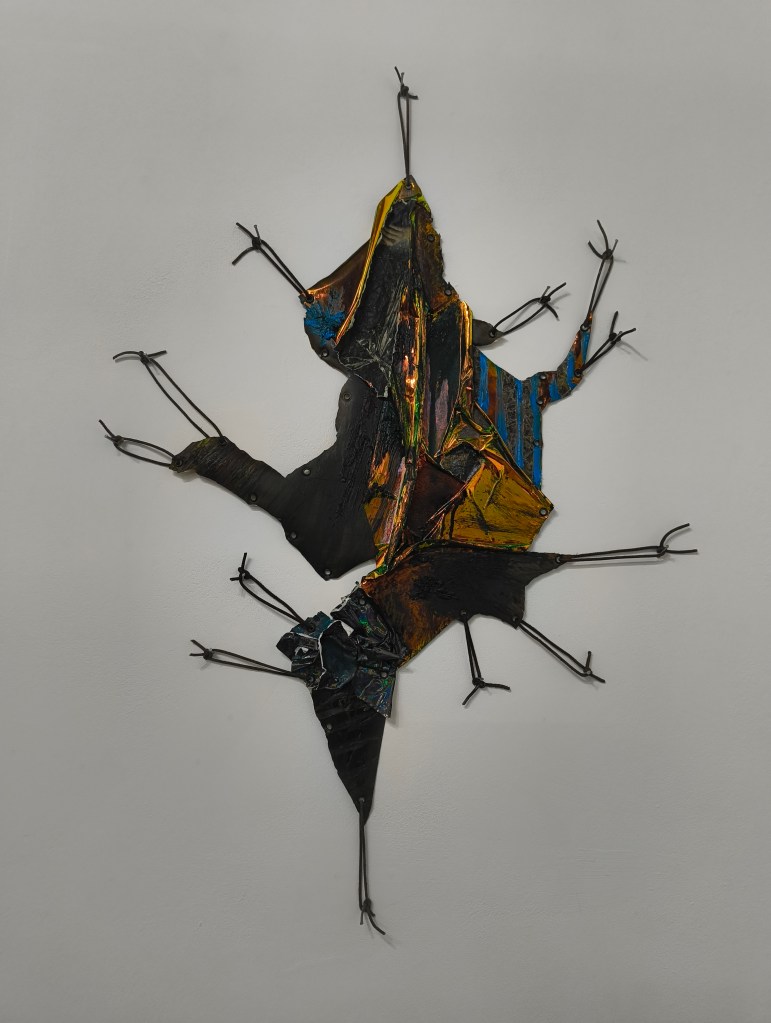
Kate Dunn’s Skin Sixteen 2025 is a work on car wrap. It is suspended akin to a tanners hide, lizard-like, alien. Perhaps a suggestion of motion, of dance. It is a rather explosive piece – directing its energy outwards, it’s glistening sheen catching the light. The ties that bind it to the wall become almost handlike, clawlike. If it is an engagement with the figure, it is far harder to identify the artist’s intent.

Visually incredible is Andrew Bracey’s Layer of Progress (The Madhouse), 2024-5. A slate grey wash obscures what I expect is an embossed image, replicating an etching of a mental asylum. Beneath it, a kaleidoscope of colours picks out details, a face here, a window there. The interplay between the hidden vibrancy and the overbearing fog create a dynamic, alive image, both elements fighting for dominance. The heavily textured surface evokes a grave rubbing, a re-engagement with the past.

Enamel on board, allowing for striking colours and forms, is Untitled, 2025, by Geraldine Swayne. Faces display unnameable emotion, part pleasure, part pain. It is as if a tincture, dropped and smashed upon the floor, produced these faces by happenstance. As if the painting captured the exact moment before they were to fade away, to blur and blend back into nothingness. Perhaps it can be read as the personification of an unknown feeling.

In amongst these untitled works, we find the incredibly evocative title 7.25pm, 2024, by Paula Newton. It manages to conjure that exact time of day, late summer, early autumn. The understanding of light and distance, of becoming an observer to an outside world working in unison. The reflective nature of concrete over water. The opalescence of a burgeoning dusk. All held in a beautiful wooden frame.
The calibre of work, and the thoughtfulness behind it all, is very evident. It appeared to me as if every painting could be read through the lens of the memory. Of forms half forgotten, of a distance between figure and viewer. Perhaps it is November, but there seemed to be a sense of deep, yet comfortable, sadness present in this exhibition. A tender, contemplative atmosphere. Each work, severed from wider bodies, became important, singular yet interconnected with all of the artwork on display. All of the artists are highly commendable.
The Problem with People is open by appointment on Saturdays, 12-4, until Saturday 6 December. @oceansapartgallery or email oceansapartgallery@gmail.com

 Caleb
Caleb 
Leave a comment