Another opening! Amidst the wind and rain, the 8am sunrises and 3pm sunsets, there are still many happenings in Manchester.
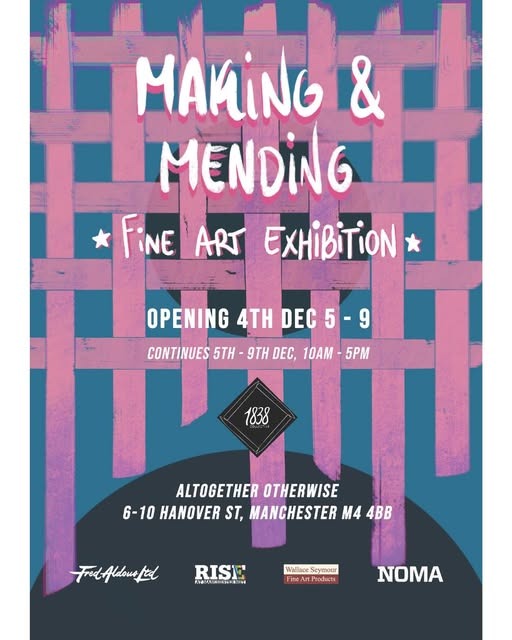
Making And Mending, exhibited at Altogether Otherwise, is the brainchild of the 1838 collective, who, having recently moved into their new Islington Mill studios, have pulled together an admirable and inspirational open call. Curated by Blake Barbose, Rebecca Garrard, and Aliya Farakh King, this exhibition displays the works of 18 artists – all responding to the rather open concept of ‘making and mending’.
Due to the broad interpretability of the theme, connections between the artworks can be – at times – hard to make. Instead, like spokes of a wheel, they return, each and every one of them, to the central idea. While expansive, there is enough of a grounding framework to keep the exhibition feeling like a justified display.
The exhibition text puts a lot of effort into touching on each of the submissions. In this attempt at fairness, it becomes a touch cluttered, but achieves respect, platforming and providing useful context as to why each artwork is here today. I do, however, feel like some artworks may have been retrofitted into the theme – artworks which I have seen at previous exhibitions. They are excellent, only their presence here suggests an arguably contrived re-interpretation, in order to match the works to the theme.
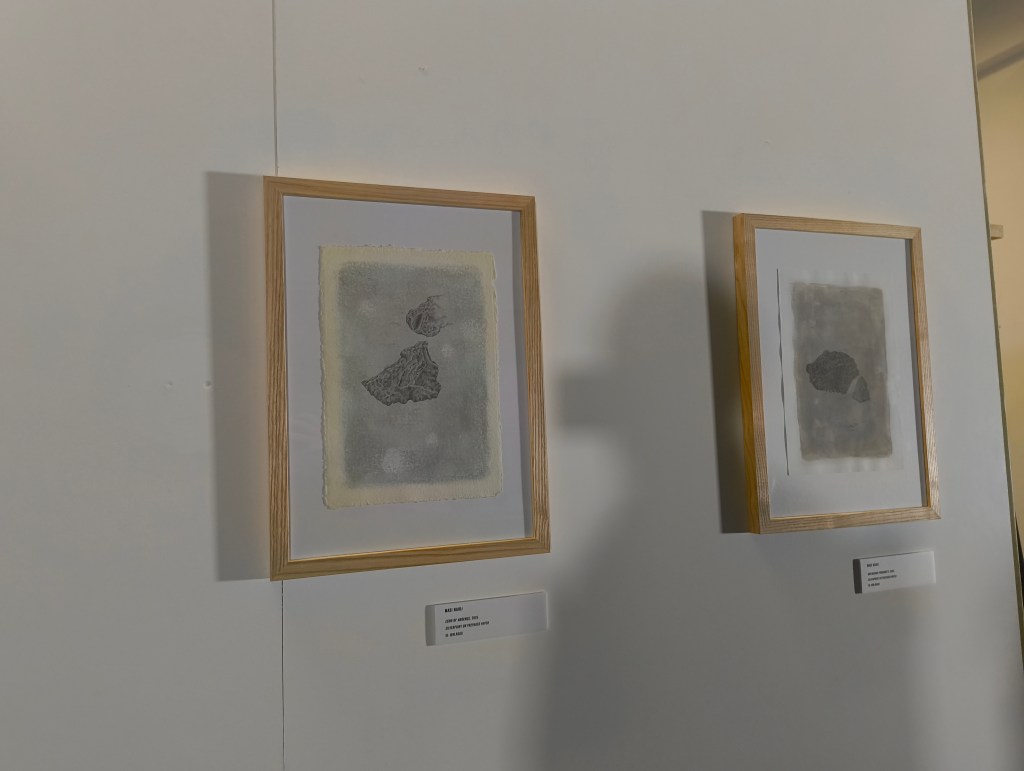
A pleasant amount of people are in attendance. There is space to move and – despite the cold – it feels lively. There is discussion, engagement, and also a lovely little print shop. I take a cursory glance, noticing some works from the 1838 collective. I might be mistaken, but I don’t think there was anything by Masi Naidj. If you’re reading this Masi, I would be first in line to buy a print of one of your works – you can hold me to that.
The space is classic – a chilly room, blue floors, big white walls. It is a brilliant space for this size of exhibition. Nothing feels cramped. Each artwork is given room to breathe, yet close enough to one another that they can be viewed in conversation. The exhibition layout is excellent; there is a well-mannered – yet non-proscriptive – flow. It allows for switchbacks, for revisiting, and – crucially – for close looking without feeling like you’re getting in the way.
Artworks are labelled with the artists Instagram handle. This is a great touch. As too are the business cards, allowed to rest near sculptures and on tables.
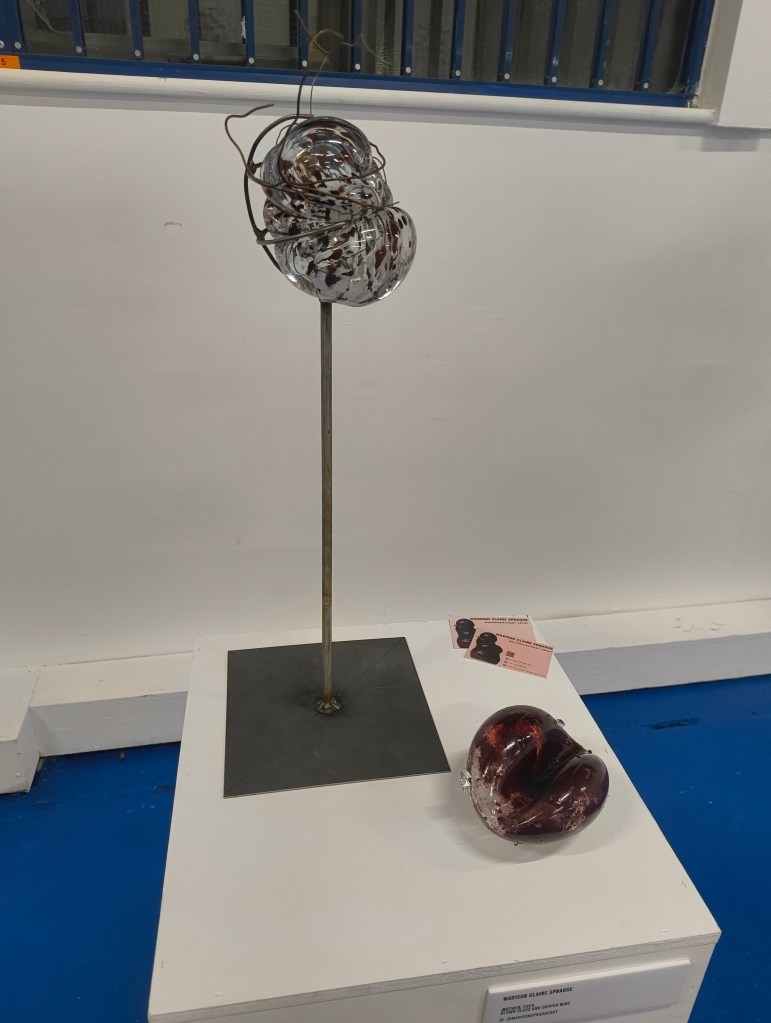
Expectedly, I am drawn to the sculpture. Madison Claire Sprague’s ‘Mother’ swiftly becomes my favourite work of the night. A nautiloid, foetal, shape – repeated both with wire suspension and without – speaks to notions of birth, to creation. Indeed, to making and mending. The glass construction is incredible, filled with mottled colours.
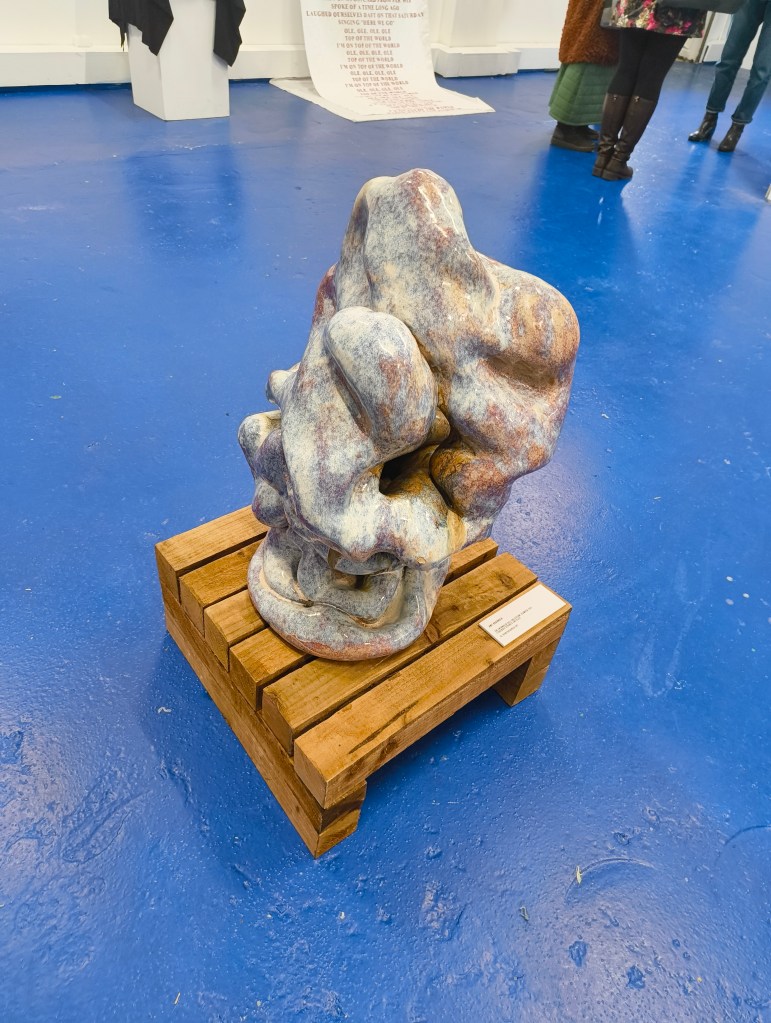
Before seeing the title, I note how Amy Bradnock’s Moore-esque sculpture seems slumped into itself. A tired looking bulging mass of clay, baked and glazed into place. It is with joy that I find that it is entitled ‘The Entangled Self Collection: Slumped’
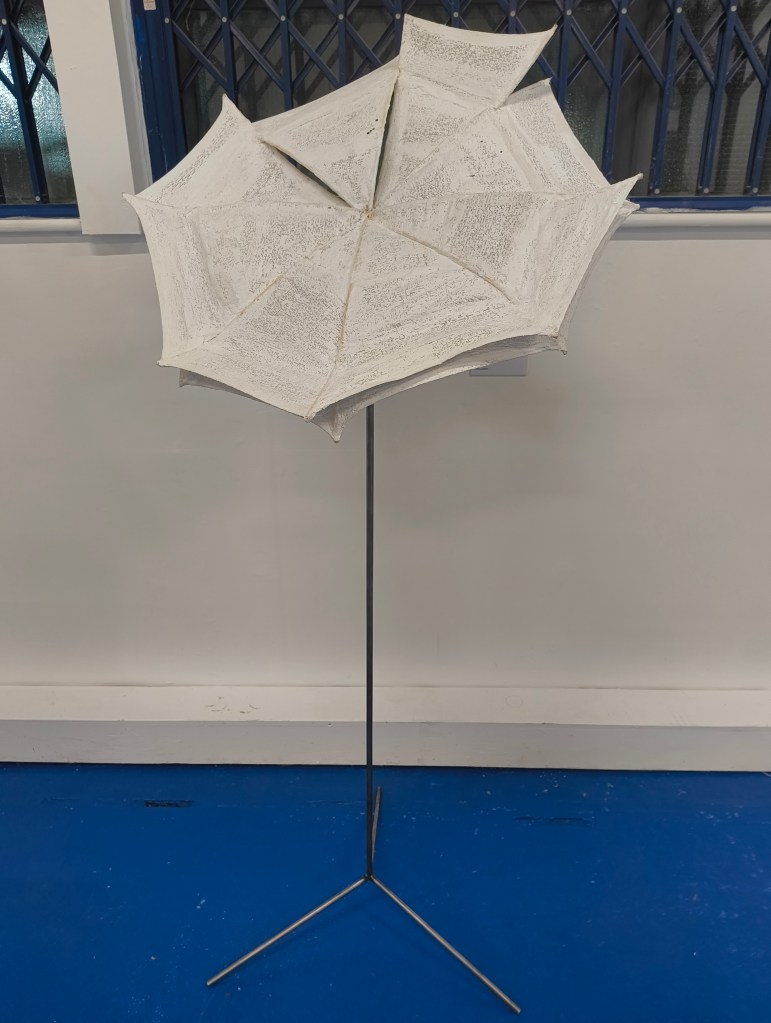
Ella Jones brings an untitled work which seems functional and fictional. A dreamed machine, solar powered, ecologically in tune and productive. There is something Sean Tan about it. Or maybe a separated, lost component of one of Jean Tingueley’s contraptions.
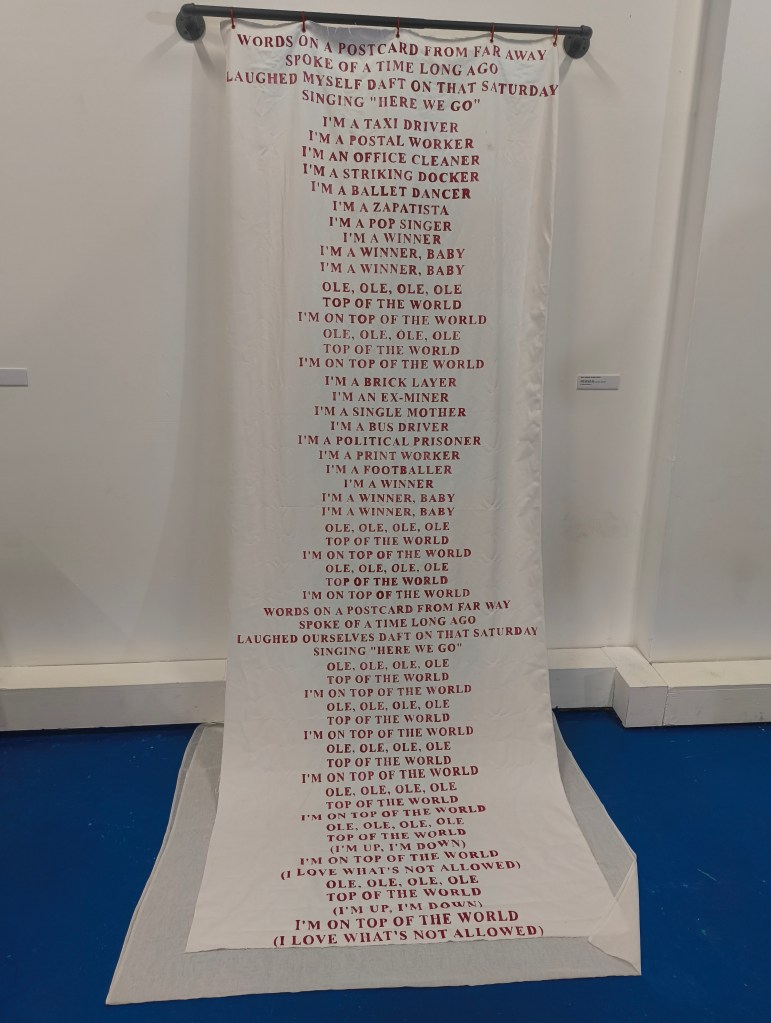
The poster piece – the one I would use to market the exhibition, is Molly Josephine Alabama Carnell’s text-based work, recanting football chants in a hypnotic fashion. Its size and tactility gives an uncanny weight to its words, the repetition sinking its claws into a viewer.
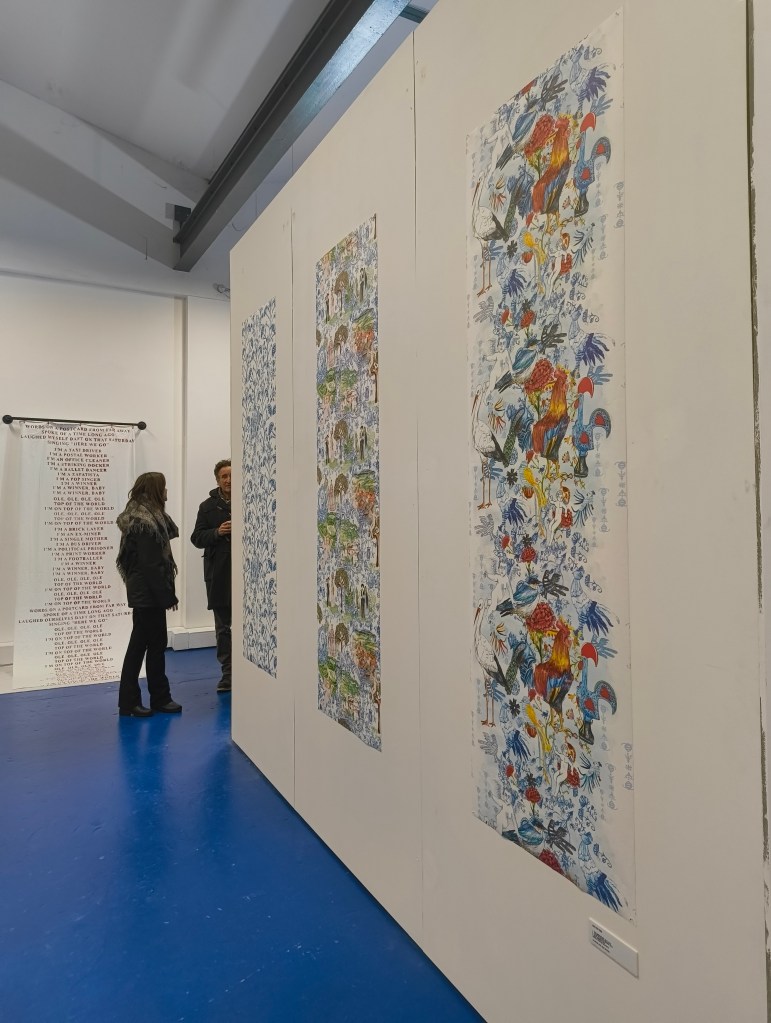
Evoking the nearby Whitworth, with its platforming of the wallpaper as art, is Ana Vera Cruz’s triptych. While not my usual style, I can appreciate the craft. Especially fun is the repetition of images between the three, not noticeable on first glance. Victorian dresses and blank faced cherubs re-appear, tying the triptych into one unified exploration of aesthetics and culture.
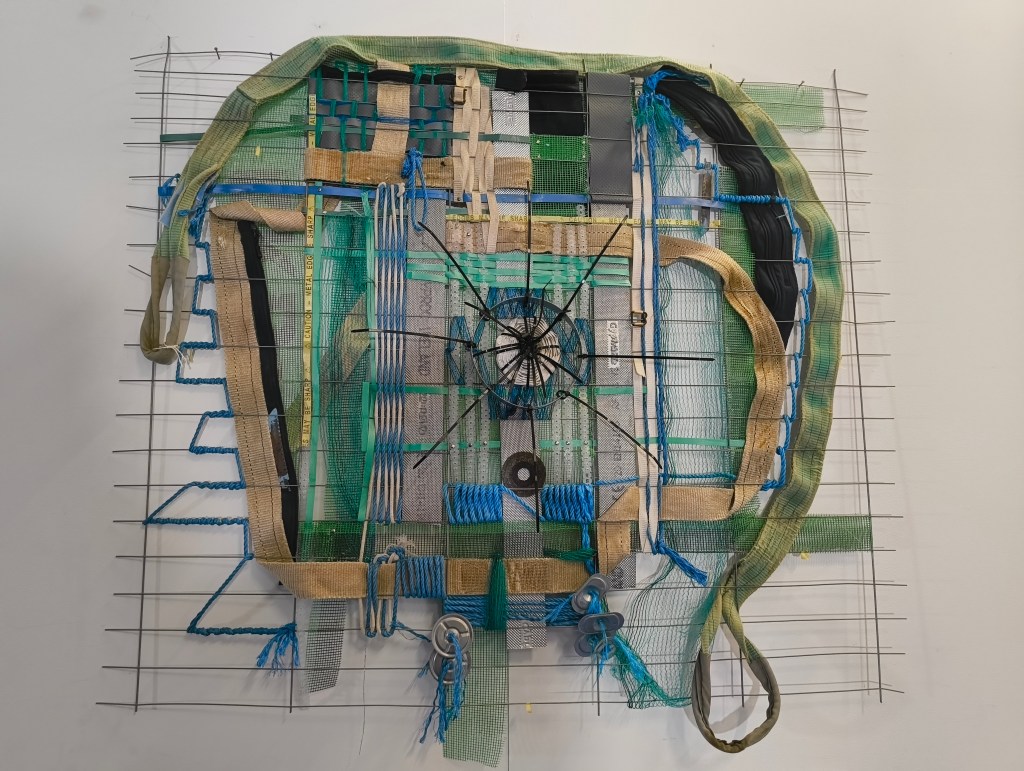
A remarkable piece is Adele Jordan’s ‘Beyond Capacity’. Re-interpolating building site waste, they weave and combine rubble and plastic, transforming it into a beautiful design, casting light into ideas of construction, it’s necessity and its impact. I would be interested in seeing a solo-exhibition of their work, further exploring this insightful and relatively novel idea.
At this point I realise a minor issue with the exhibition. I am often blinded. In lighting the space, two floodlights have been angled, reducing shadows and illuminating the room. It works fine – for the most part – besides two considerations. On occasion I cast a shadow on what I am looking at. On other occasions, an accidental glace provides a full face-full of light, at full blast. It is a justified adaptation to the space, with an unfortunate side effect. As long as you look at the artworks, you’re fine. Look around the room and you risk blinding yourself somewhat.
Technical details aside, this is an impressive and engaging exhibition. Each artist brings something different to the table, most responding in identifiable and insightful ways to the theme of making and mending. The individual works range from pleasant to genuinely interesting. The curatorial process must have taken a lot of work – I can’t imagine how many responses there were to the open call, but I can image that the selection process was quite intensive. There is thought and care in the selection and presentation.
Making and Mending continues until 9 December 2025, and comes accompanied by a series of talks and workshops.

 Caleb
Caleb 
Leave a comment