The loss of a gallery space dealt a severe blow. Of course, temporary exhibition space remained a nebulous possibility – however, with Smolensky Gallery taking a more sales-focused direction, my priorities were no longer those of the business.
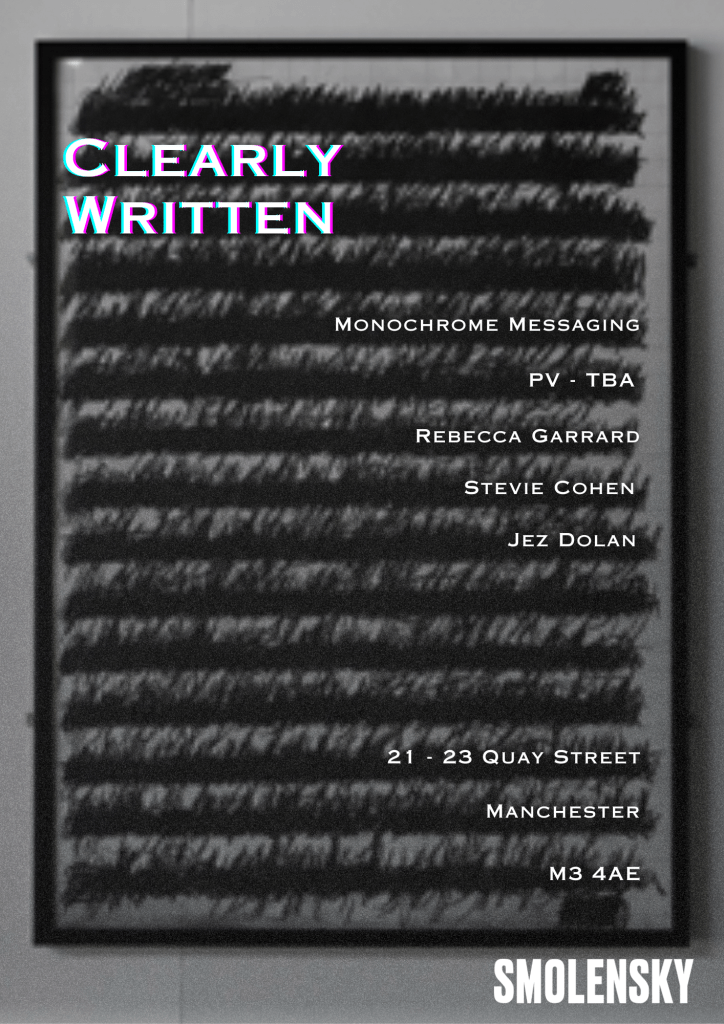
‘Clearly Written’ was originally intended to open in December 2025. This date was pushed, due to re-decoration of a space we were barely hanging on to. Any subsequent re-schedulings unceremoniously disappeared. An email. Stating that the building in which we were housed was ‘going in a different direction’. The possibility of the exhibition vanished.
Here, in lieu of the actual exhibition, is a summary of my intentions, plans, and thoughts. An ersatz exhibition.
The Artwork/Artists
I first met Jez Dolan in October of 2025. His studio space in Paradise Works is well lit. I arrive – as ever – before my boss, and am treated to a cup of herbal tea. Jez is lovely. Warm, intelligent, and an excellent speaker. He tells me of his various artistic directions. A mind-map up on the wall behind him seeks to capture the network of threads he is engaged in. A centralising concept – Neolithic Camp – works its way through his current output.
It is here that I find his Magpie series. An obfuscation of an obfuscation of an obfuscation. A letter, written at the end of a relationship, is encoded into sheet music. It is further obscured by great swathes of paint. A series of twelve.
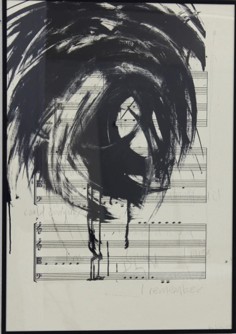
Jez, here, engages in a peculiar, contradictory process. The original content of the letter is unreadable – levels of code separate it from the audience. Yet, by making it large, by displaying it, the emotional vulnerability at the heart of the piece is made accessible. Sentiment is both hidden away, and presented for all to see.
Now, our gallery space was a corridor – and there were rumours that Building Management wanted to paint it red. A literal red flag. Nevertheless, I believed I could put on an exhibition. Not knowing what colours the walls were to be, I opted to stay minimalist, and hand-pick a selection of monochrome work.
A relation of a friend of my boss, I was brought into contact with Stevie Cohen. We met, out of hours, at an exhibition on display in Altrincham, with a view to work towards an agreement to sell her works.
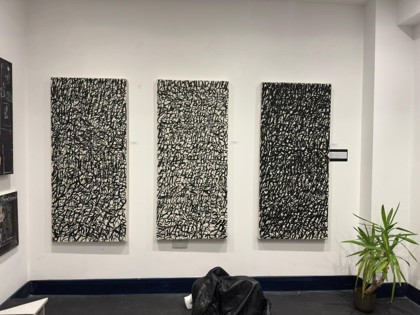
A selection of her works really spoke to me. One, a triptych, superimposed numbers on top of one another, each iteration more complex than the last. In conversation, she expressed her wish to create two more, reaching almost 100% coverage of the canvas. Another pair of artworks displayed flowing white writing on a black background. The words ‘for ever and ever’ sprawled, reaching beyond the edges of the canvas.
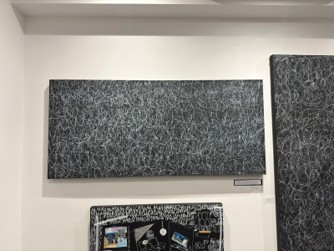
A third piece by Cohen was the product of her time as lecturer for the Fine Art course at The University of Salford. She told me of a task she used to set her students. 500 works on paper by the end of the week. An impossible task by conventional means. Her solution – the instructions for the task in 500 words, each marked as an individual work on paper.
Again – monochrome artworks. Text based. Writing and the written word. A reimagination of communication as artwork not literature.
My final proposed artist was to be Rebecca Garrard. I had gotten to know her through shows her, and the 1838 collective, had staged. Her gestural abstract works fit my rubric. A translation of movement, through ink on paper, into beautiful artworks.
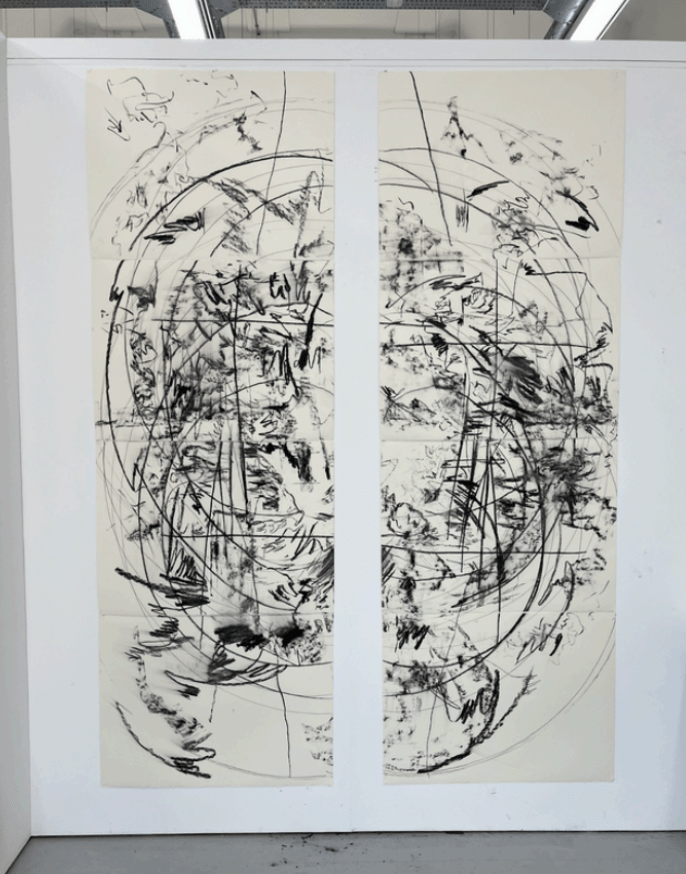
However, my drive to stage an exhibition – and my reliance on Smolensky’s access to gallery space – led me to oversell. In a meeting with Rebecca I talked her through my ideas, and the timeline for the exhibition. She agreed to send me a portfolio of potential works. I picked out a selection and she put aside time and grant money to get these framed. I believe this to be my biggest failure and regret from my time at Smolensky. I had cost an artist money, and wasn’t able to provide any support. I feel responsible for this – had I became less starry-eyed, and paid attention to the red-flags and complexities that were arising all of the time, I could have saved Garrard from these framing costs.
The Plan Falls Apart
The exhibition was planned for late December. I had presented a pitch-deck to my boss and had gotten the sign-off. He had forwarded it to the building management. A statement, of what the Gallery can do – and should be doing – with our physical space.
Yet, there were clear issues. We didn’t have an insurance policy for artworks in the gallery space. The turnaround for set-up would be tight. No matter, I thought, I only have three artists, and can invest my personal time to the installation. There was friction between my proposed exhibition and the current culture of the gallery – a tonal dissonance between selling prints and editions and displaying emerging artists. Our space was a corridor – publicly accessible thus complex to host an opening in. And, most keenly, I was kept in the dark as to the details of the arrangement which secured our gallery space.
So, the December date was pushed. No worries, I thought. This will give me more time to promote the exhibition and get a firm date for installation and take-down. I contacted the artists and they were on board with this.
Then January rolls around. The exhibition is at the top of my priorities. Not only for my personal professional development – to have an ‘exhibitions curated’ section of my CV – but also for the benefit of the Gallery. I wanted to provide grounded, tangible cultural legitimacy. Without using our exhibition space, we risked becoming a solely online venture. A shop-front for art, and a tool to connect collectors with dealers. Not a cultural institution, and by no means an organisation that enables artist development. Staging an exhibition – I argued – re-focused our mission, while also boosting visibility and gaining traction for the commercial sides of the business. If we claim to be about ‘art for the many, not art for the money’ – then we should put our money where our mouth is.
So, together with the director, I pen an email to the building management, outlining our plan for 2026 – centering my exhibition as a jumping off point for a slate of cultural events.
It is a Friday, around 6pm, when I receive a message from my boss, saying not to worry about the recent email. The email in question was from the top-dog, the person who controlled the entire building. Very clinically, we were informed that management wanted to go in a different direction, and our role in the space was no longer possible.
There is a version of events in which I bounced back from this. In which Smolensky Gallery gained access to temporary exhibition space. Pop-ups, exhibitions, shows, open-calls, spearheaded and curated by me. But the writing was on the wall, and had been for some time. I plan to explore further my reasons for leaving Smolensky in a separate post. For now, it is suffice to say that I can’t see a world in which this exhibition would ever happen in this organisation.
Conceptual Justification
The initial grouping concept was purely aesthetic. I needed works which could hang on a wall that might be white, might be maroon. In truth, the conceptual framework of the proposed exhibition was born from this limitation.
The exhibition was to be framed as a ‘space takeover’, with one half of the gallery corridor reserved for more commercially viable prints, the other half handed over to me, to curate. We had planned on having 3 – 4 shows per year. A low amount. My boss didn’t want too much time to be taken up by exhibition logistics. My intention was to use these shows to platform Manchester-based emerging artists.
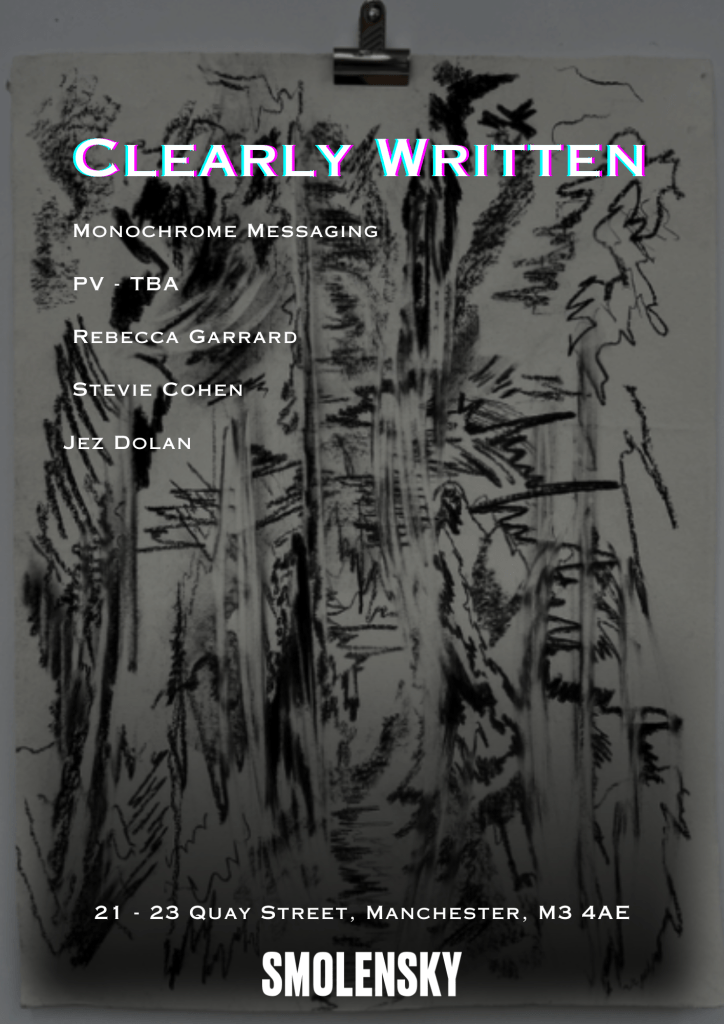
I designed posters, flyers, and a brochure containing the conceptual justification of the show. The following is the core exhibition text:
“Clearly Written brings together three artists living and working in Manchester. Between them, concepts of expression, concealment, and communication are brought to the fore.
Through art, we can obscure and reveal our thoughts. Abstraction as a form of encoding – transmuting our inner self into visual form. We take a thought, a feeling, and hide it away beneath layers of ink, charcoal, acrylic.
Yet, here, these thoughts are made visible, presented large in front of an audience. Unlike the diary – bound and kept hidden – these artworks are on display. They present a challenge, an invitation to engage.
Meanings beneath such art is varied. Through these artworks we begin to see the heart, the body, and the mind.
Jez Dolan, in his Magpies, files away an emotionally intense ending to a relationship – a letter transcribed, set to music, printed, and hidden. He simultaneously bares and shields his heart.
Rebecca Garrard, through yogic and reflective practice, translates her body, her motion, onto paper, allowing a physical language of movement visible form.
Stevie Cohen explores the infinite, both sequential, numerical, and in writing, her text ignoring the confines of the canvasses edge, a mind unconstrained by space or time. An expression, an investigation of the unending nature of love.
Language – text in its various forms – is brought to the surface in black and white. By stripping away colour, we see more clearly the communicative intent within. Ink on paper, paint on canvas. Yet, unlike the diary, here there is no cover, no binding layer maintaining secrecy. Instead, transmutation of text into artwork reconstructs mystery. The privacy of the diary returns – the artworks have no single reading, suggesting different thoughts to different viewers.
To put such messages on display can be difficult. Obfuscation though art becomes a mean to enable sharing. While the content of the messages is personal, in some cases private, their public display allows for conversation. Displaying these works is an incitement to speech, a reckoning between one’s private thoughts and one’s public voice.
The artistic process of creation is a process of encoding. The practice of viewing as an opportunity to re-engage with our thoughts – of body, heart, and mind. An invitation to further communication.”
End Quote.
I thought I was on to something. There were enough interplaying themes that the exhibition didn’t offer a monovocal interpretation of the art, yet still could guide a visitor to a deeper reflection.
I envisaged a feedback wall, for visitors to create their own graphic text art, transforming their written thoughts into an aspect of the exhibition. A further reading list, signposting Lawrence Weiner, Carl Andre, Hanne Darboven, and others using and obscuring text in their artwork. Perhaps even a series of talks, inviting the artists to speak to the central themes and outline their own practice. Just something to claw the gallery back from its almost single-minded focus on the commercial art world.
Reflection
It would be simple to place the failure of this exhibition at the feet of Smolensky Gallery. Too simple.
My main takeaways from attempting to curate this exhibition are as follows:
1) The spark for this exhibition was the need to fill space, to prove a point, and for professional development. It wasn’t about the artwork, or about a want to explore a theme. The core ideas allowed for better selection of artwork, but were constructed artificially. This would have resulted in a conceptually shaky show – in which most of the intellectual effort is spent on justification rather than exploration.
2) I acted unilaterally – arguably within the structure of my position at Smolensky – rather than with a team. There was no co-collaboration. Rather, I borrowed artists’ ideas so that I could pull together a show. This meant that my departure from Smolensky sounded the death knell of this exhibition. In assuming responsibility for every part of the exhibition, it could only have come to fruition through my actions. In this way I am responsible for its failure.
3) My access to artwork was limited by my network. In order to curate a show of primary artists’ works, I need personal connections with these artists. By attempting to curate a show after only half-a-year or so of engagement in Manchester’s art scenes, I was limited by the extent of my connections. My position at the Gallery and my review writing had started to get me into contact with useful people. Only I overestimated how connected I was, resulting in a limited pool from which to draw from.
4) Misreading institutional culture and getting fixated on personal goals lead me to believe that this exhibition was possible in the first place – resulting in wasting time and resources, both my own, the galleries, and those of the artists I was to be working with. It was my responsibility to understand Smolensky Gallery’s strengths and weaknesses. In turning a blind eye to the weaknesses I constructed a false world in which we had firm access to gallery space, and the time and resources for me to curate shows.
5) To achieve my goal of curating this exhibition, I would have had to sacrifice much more than I was willing to. My dissatisfaction in my position at Smolensky Gallery led to me leaving. The only way this project would have worked under these circumstances would have been to have put much more energy into seeking temporary exhibition space, and continuing to work there despite my disagreements. In a sense, I wonder if I could have powered through. This reflection, however, contradicts my second reflection, as to push through and stage the exhibition, I would have had to continue to work unilaterally, having to fight for any support from Smolensky Gallery.
Takeaways
So, the exhibition won’t take place – at least, not under the banner of Smolensky Gallery. Maybe in time, I will be able to find temporary exhibition space on my own, re-establish relations with the relevant artists, and bring this project to fruition.
However, the process has been instructive. I feel that – even if the central themes were a retrospective justification of aesthetically functional artworks in an uncertain space – the themes had a bit of bite. In speaking to the artists, I have a better understanding of what artist development takes, what artists need, and how galleries can provide support. I understand better the pressures of staging an exhibition, the constant negotiation with other priorities to justify and support what is, ultimately, a non-commercial venture. And I understand the ways in which my actions and ideas contributed to the failure.
I hope to someday curate exhibitions, not to fulfill any self-aggrandising notions of professional development, or to appease the logistical and economic needs of an institution, but out of a genuine desire to explore the world and our place in it through the art of those actively engaging and producing complex and novel works. Art has value in its ability to provide an entry point to difficult questions. To not necessitate a simple answer. While it may have been ‘Clearly Written’ that this project was doomed to failure, I am glad for the experience it has given me.


 Caleb
Caleb 
Leave a comment