With the sun shining outside, I take respite in the cool of the Serralves Institute. I have been walking all morning, and endeavour to walk some more as I set foot into the galleries contained within the modernist building.
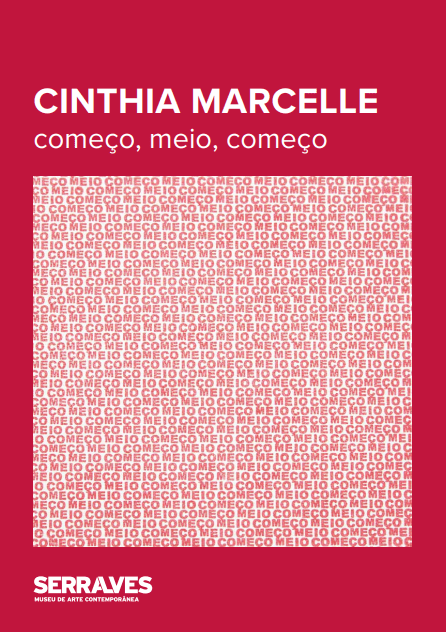
My first encounter is to be my most significant. A tone setter, hard to approach and engage with, but inimitably powerful – creating such a dual sense of dread and awe. It is so impressive, in fact, that it kicks me out of a month long stupor and reminds me why I engage with contemporary art.
Cinthia Marcelle is a Brazillian artist operating in a post-avant-garde world, navigating post-colonial reverberations and social tensions. A multi-media practitioner, she has a strong CV, having represented Brazil at the 2017 Venice Biennial. Here, in Porto, she has constructed a deceptively simple creation.
começo, meio, começo {trans: beginning, middle, beginning} begins with a thick red curtain. From within comes the rhythmic sounds of metal on metal. An abstract audio perhaps invoking industry. The curtain seems to be without seam. It is only when consulting the map that I realise there is an entire room beyond it. The threshold must be crossed. I feel unsettled, avoiding the glance of a gallery attendant to slip behind the fabric into the darkness beyond.
I have entered a different space. A different state. It is dark, almost completely but for a faint red glow from behind me. Turning around, there is a clock-face, illuminated from behind. It has no hands, nor numbers, only twelve demarcations. It’s central node transforms it perhaps into an eye. It is the only consistent light source. A naive reading sees this room akin to a cinema, perhaps, with felt lined walls and near-darkness.
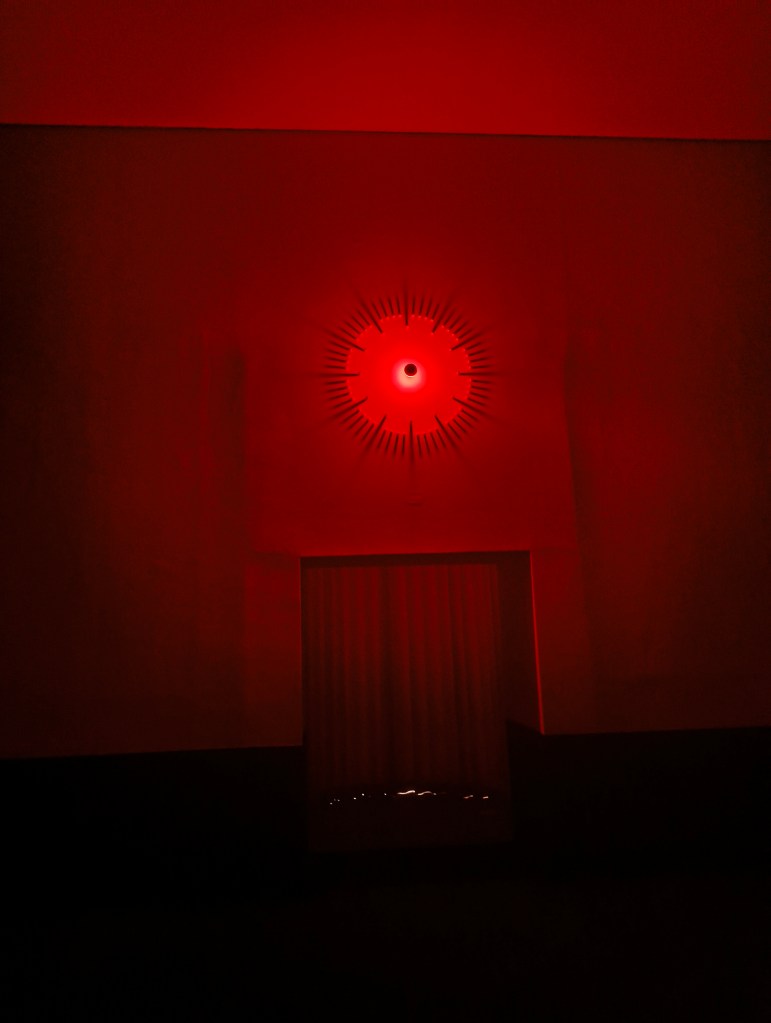
It takes a number of minutes for my eyes to adjust to the dim. Two others appear out of the gloom, exiting the room. It is a relief that I did not encounter them within the central void, as I may have jumped out of my skin. They are silent, reverent. The thick curtain at the threshold stops any external noise. We are left with only the sparse contents of this unseen room.
Beyond a ramp, that snatches back on itself, slowly descending deeper into the space, is the only other thing here. A number of bars – tubes of light – are spaced out on the floor, seemingly at random. They intermittently flash red, and are accompanied by a resounding clack. These bursts of light and noise are few and far between, and for extended periods of time, I am left alone in the dark, hoping that no one else is in here with me, waiting.
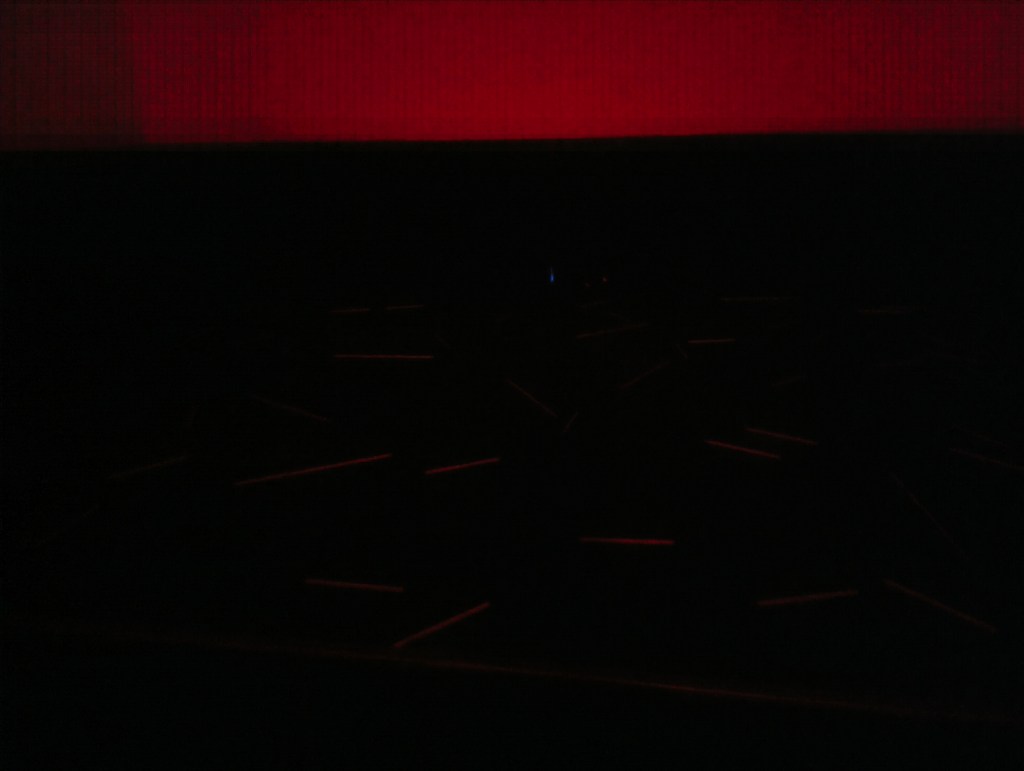
And that is the entirety of the exhibition. I stayed, for less time than I would like to admit, then went. The darkness was simply too much. I was on edge, unsettled by the lack of anything concrete. No indication of time – no hands on the clock. No rhythm to the faint flashes of light and sound from across the gallery floor. No indication of other people thanks to the gloom. Nothing recognisable, nor even immediately relatable. Quite incredible, really.
The exhibition clearly states that there is ‘no clear narrative’. It operates under its own logic. ‘The memory of ancestral forces’. The text, accompanying the exhibition in the folds of a very professional brochure, is extensive. It draws strong parallels with other artworks and installations – ones I have never heard of, am not even near to the same conversations.
An interesting passage explores the clock-face:
The ground-level interplay of light represents the passing of the seconds, but stripped of their purpose to order and regulate. A gesture subverting the unbending logic of linear time, embracing a wealth of discontinuous, coexisting rhythms[…]
Ines Grosso, the curator and author of this excerpt, links this discussion of the de-linking of time to the intellectually constricting nature of colonialism, capitalism, and even monotheism, in which all is sought to be catalogued, described, and understood. The sporadic nature of the pulses of red light become an expression of plurality. An anti-hierarchical manner to note the passage of time.
In exploring the theme of exploitation through colonial organisation, I start to understand my unsettled reaction to the exhibition. I am, in some senses, the legacy of the coloniser. I have been educated in a fundamentally Western, modern (arguably post-modern), manner, and I am used to – and comfortable with – the forces and structures which this exhibition summarily deconstructs and problematises. My disconcertion is intentional and highly successful. I am beholden to the rhythms and structured ways of thinking that influence the colonial mindset – no matter how far I go to unlearn them, they will – at some level – remain.
The power of this exhibition is that it managed to remove me from linear time. A transposition I found deeply distressing. In my distress, I can come to a deeper understanding of my own assumptions, biases, and unaddressed coloniality.
Grosso writes that, ‘The project challenges us to reconsider all we take for granted – the linear nature of time, the order of things, the way we live the world – and invites us to contemplate contemporaneity from another decolonised and pluralistic perspective, capable of renewing what we have inherited from the past’.
They are right. Through Marcelle’s artwork I have been challenged, and I have accepted the invitation to contemplate. A resounding success.

 Caleb
Caleb 
Leave a comment