The sun is out in full force as I walk Lordelo do Ouro. My destination: Serralves. This Contemporary Art Museum sits within an expansive grounds and sculpture garden, and is home to a number of exhibitions. Entrance usually costs €24 – yet, with just the right amount of fraud, I managed to alter my student ID, allowing me half-priced access. In hindsight, the experience is well worth full price.
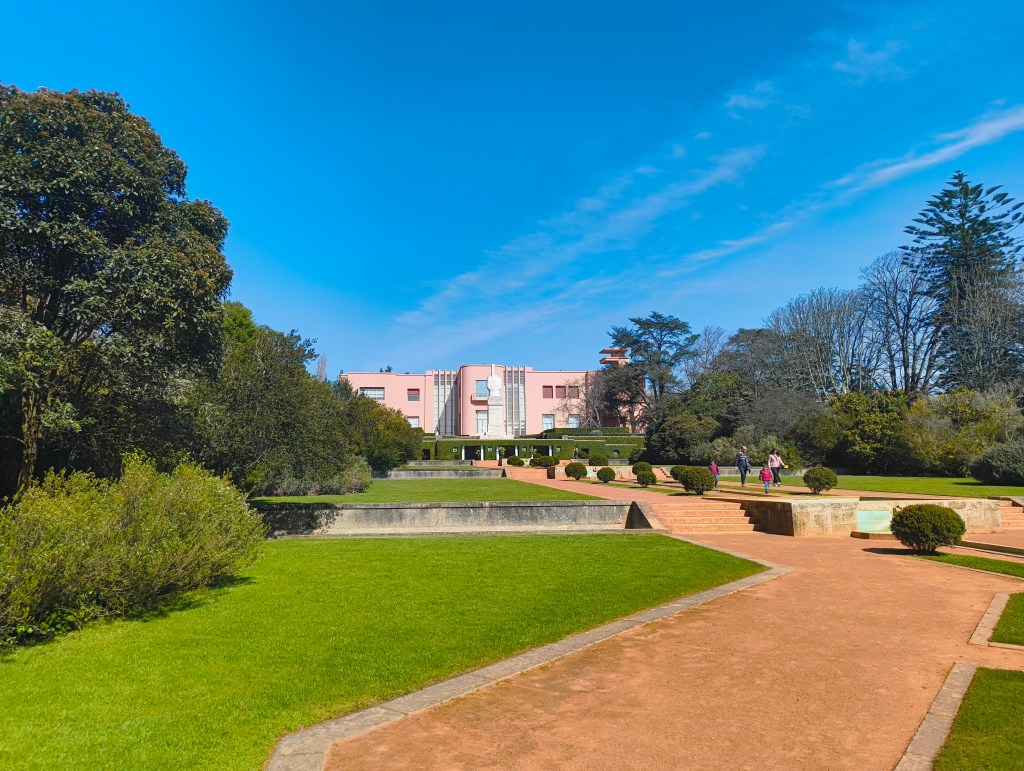
Serralves – or Fundação de Serralves in the proper Portuguese – contains a vast amount of art. To fit my entire review into one post would be foolish. This review will concern the grounds, and the sculptures found within them.
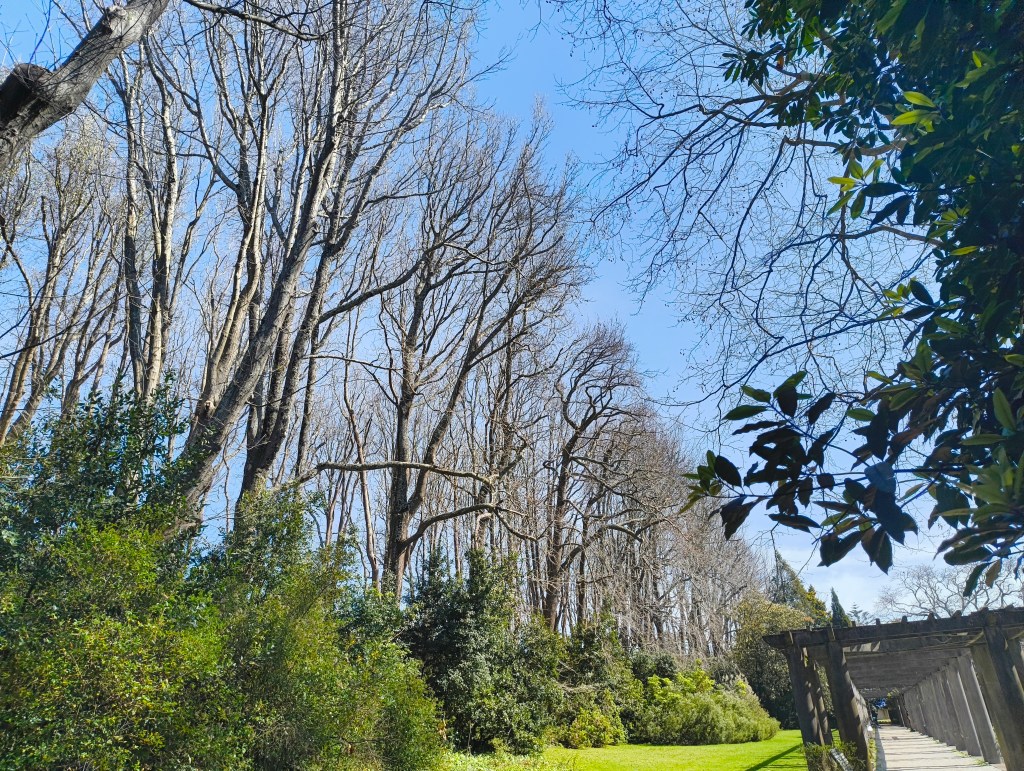
First opened in 1987, The Serralves Foundation – from what I can discern – acts as a QuaNGO – a quasi-non-governmental-organisation. The main area sits on the site of the Cabral family estate – an old textile manufacturing family. It’s gardens, a well manicured 18 hectares, contains both tree-top walk and ornamental farm. The weather is warm, the sun casting its rays through the Sweetgum trees. Promenades are flanked by great Azalea shrubs with vivid pink flowers.
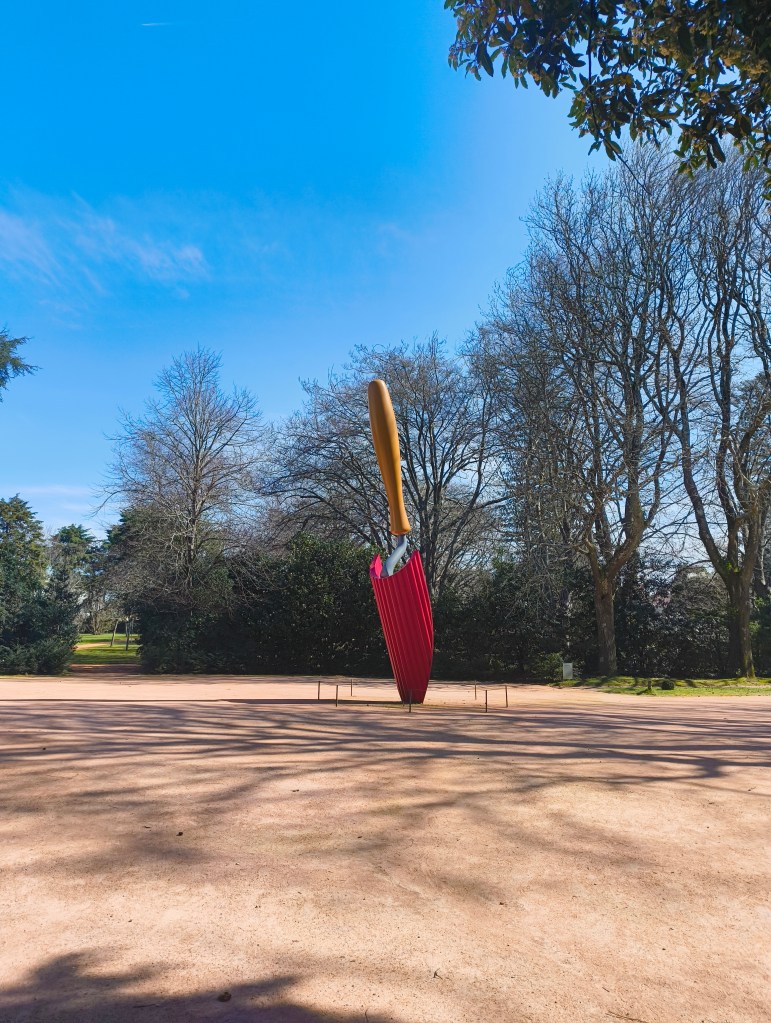
14 sculptures are dotted around. The scale of the garden allows for impressive displays, as well as a number of more discrete, hidden artistic moments. The first sculpture I encounter is Claes Oldenberg’s Plantoir. Not being a huge fan of Oldenberg’s pop art sensibilities – once you’ve seen one deconstructed mickey mouse, you’ve seen them all – I arrive at the monument with a sense of scepticism. The large trowel – created by Oldeberg and Coosje van Bruggen – sports bright colours. It is playful, and taps into his running theme of decontextualisation through scale.
For me, making the familiar unfamiliar can be quite an interesting action. However, a trowel in a garden, no matter the scale, challenges little. It is a pleasant object, and a viewer can walk all the way around it, allowing for new angles of viewing. In fact, through a great iron gate, this sculpture can be seen from outside the walls of the Serralves Foundation. In this manner, I believe this sculpture to be a functional entry point, and good advertisement, but a tad shallow. It looks pretty, and it is a recognisable form. But how much can a trowel in a garden really say?
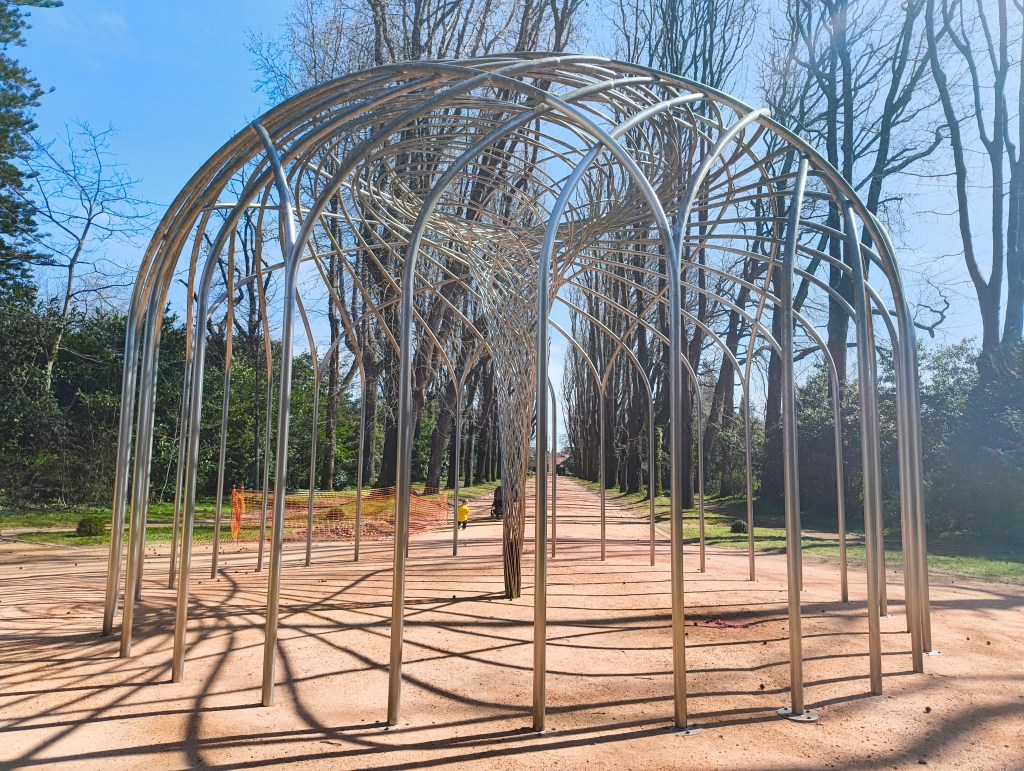
Moving on from Oldenberg, I find Olafur Eliasson’s The Curious Vortex. Now, I never saw the weather project at Tate Modern, so it is exciting to come up against one of Olafur’s sculptures. This twisting mass of metal is remarkably gentle. It’s vortex form evokes a merry-go-round, or perhaps a weeping willow. In the sunlight, it sits beautifully and brightly at the point where many paths branch off. Conceptually, we are told by a small placard, the work relates to the role of the museum in society. “Just as the force of a whirlwind develops around a rotating centre, museums also have the ability to channel thoughts, ideas feelings, affections.”
This is a nice justification of my passions. And, indeed, this description allows me to alter my perception, re-polarising the inwards motion of the vortex to an outwards, centripetal force, spreading further, sending energy outwards into the world. On closer inspection, the construction is complex and non-symmetrical. A tangle of ideas spun up around itself and pouring out. I like this artwork.
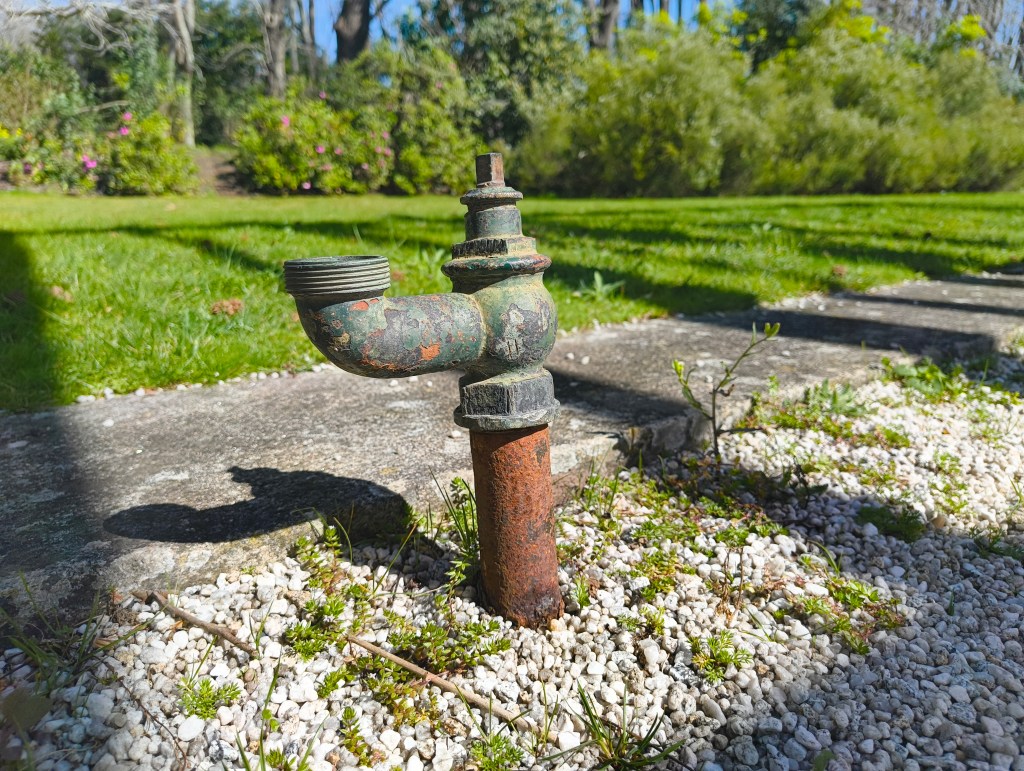
I stop to take a picture of a faucet. In a space designated for the presentation of sculpture, it is interesting what else we can see through an artistic lens. The distinctions between nature and man-made are already blurred through the cultivation of specific species. Even more blurred by the interactions between art and plant.
This interaction can be seen in Carneiro’s Ser Avore e Arte [Being Tree and Art]. Pits and mounds surround a tree, questioning the boundary between the body, the art, and the natural. Reflections of the tree in the glass create a new fusion. The fact that the tree was, at one time, planted for the express purpose of human enjoyment within the assemblage of the gardens only adds to this interplay.
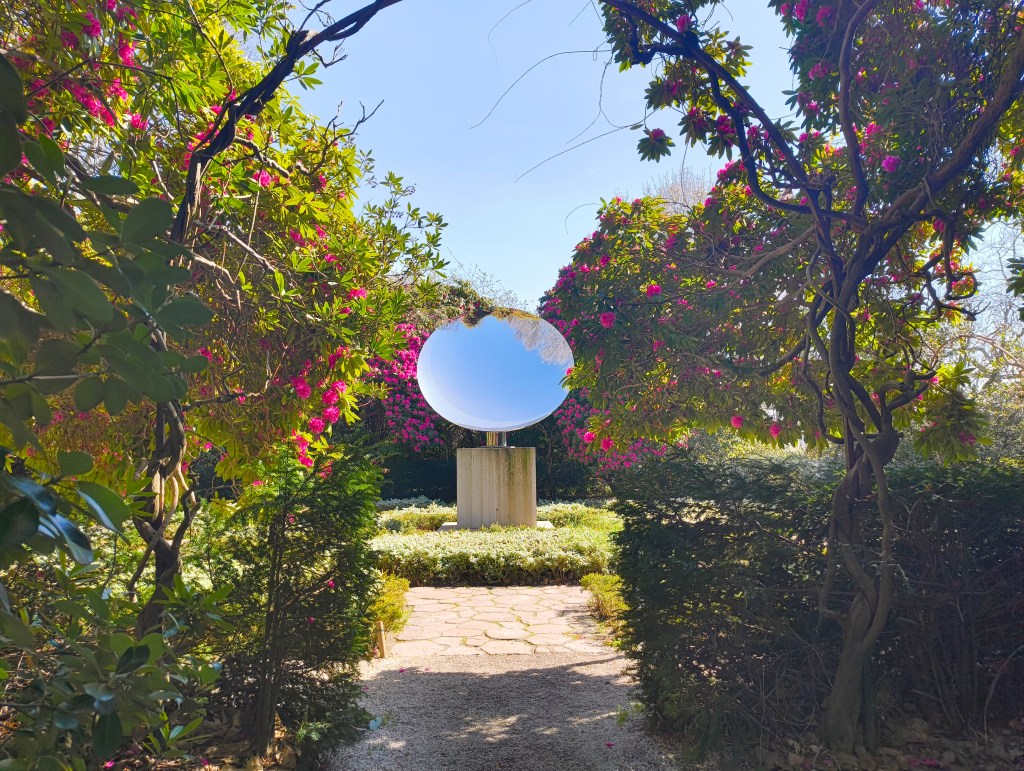
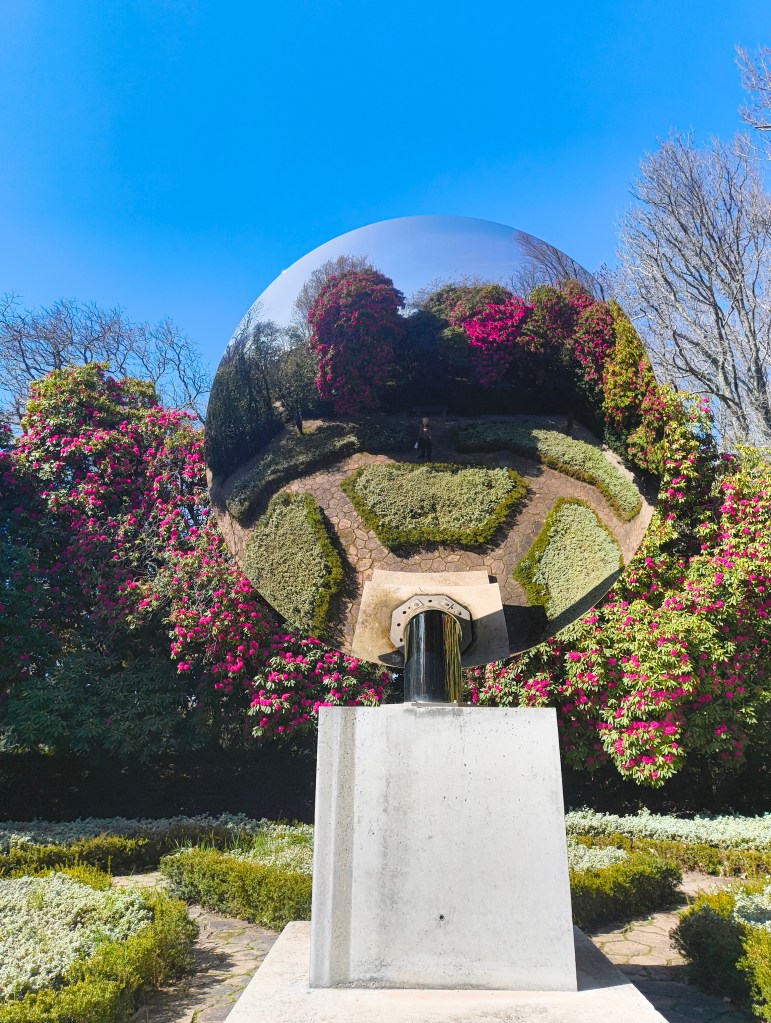
Perhaps the most photographic sculpture comes from the occasionally-derided Anish Kapoor. Sky Mirror has been displayed around the world {First exhibited in Nottingham}. A concave mirrored dish, with convex underside, the artwork inevitably reflects the environment it exists in. In New York, it captures a slice of the sky and traps it down amongst the foundations of the skyscrapers. Here, it takes the beauty of the day – bright blue skies and vivid pink flowers – and condenses them into a focused point. I am taken in by its charm. Sitting in a glen, it reflects the garden both in image and spirit.
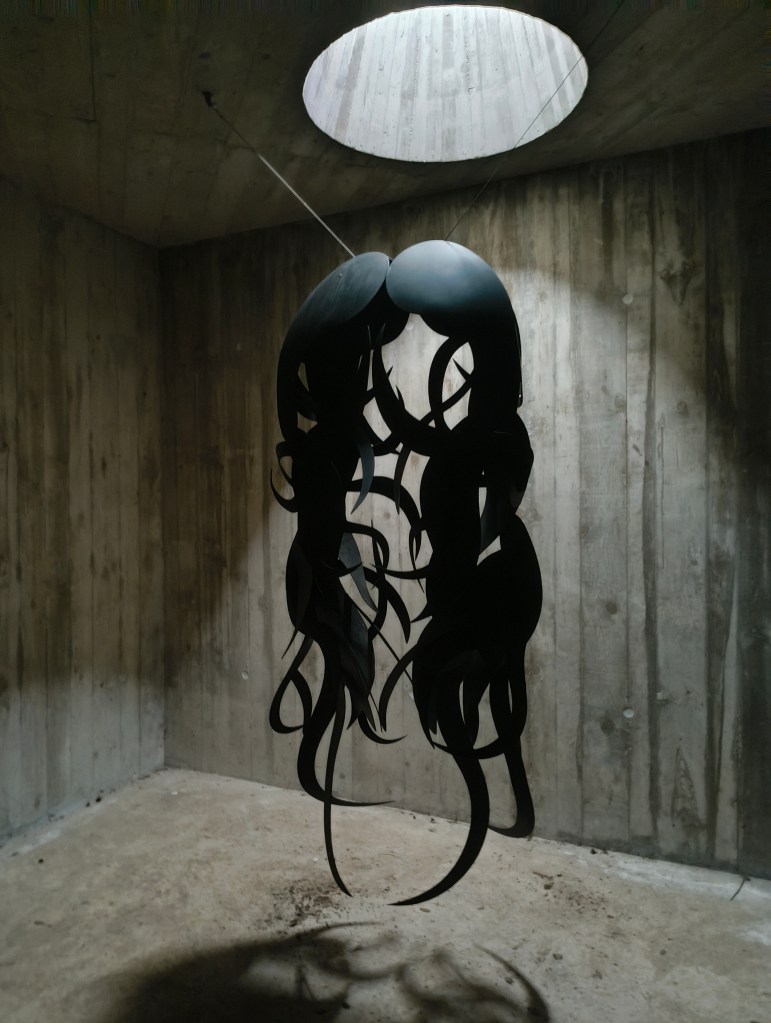
Making my way past the tree-top walk, I stumble across the site of a much more sinister artwork. Rui Chafes’ Travessia [Passage] is only viewable in daylight hours. To find it, one must make their way down a narrow winding passage into a cold bunker, lit only by a narrow skylight. Inside, an ominous form, resembling a disembodied wig, floats – suspended by wires invisible in the dim light. Its borderline organic form is unsettling, the low light and cold temperature setting me on edge. I feel as if it will suddenly animate, whip forwards and confront me. With the addition of only one way in and out, I leave quicker than I would like to admit.
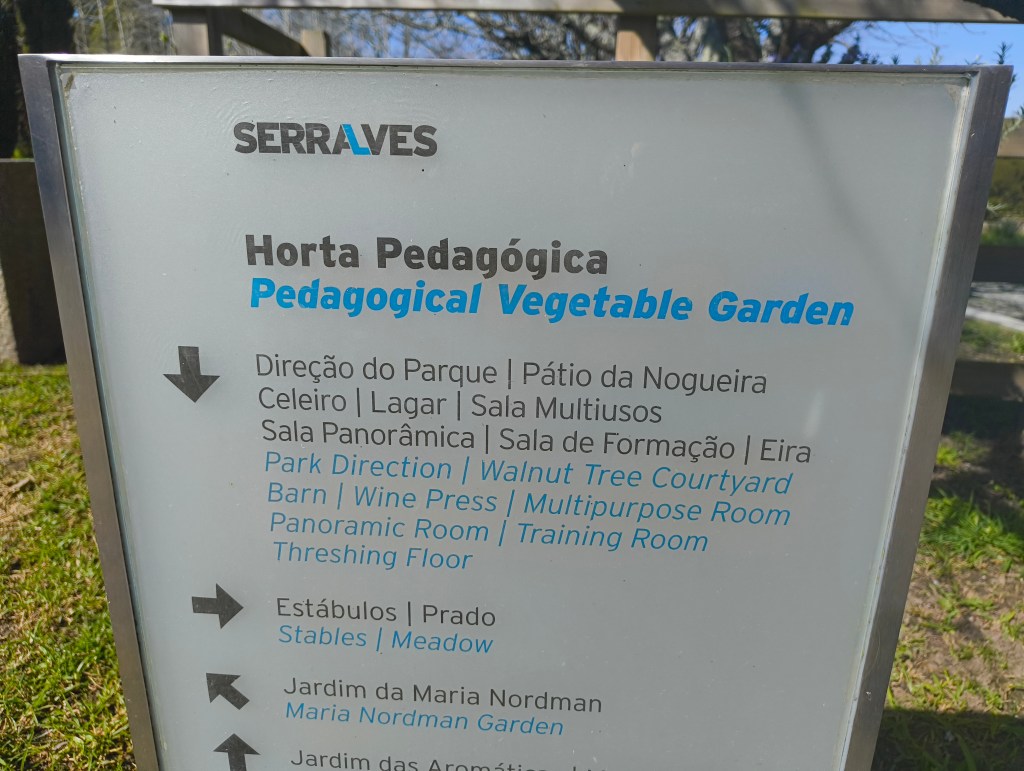
I pass by the herb garden, and the charmingly named ‘pedagogical vegetable garden’, and stop by an exhibition in what appears to be an old grain barn – a matter for a different post. The grounds themselves are lovely. They’re not too expansive, as to require a hike, but large enough that you feel like you are in a place separate to the city.
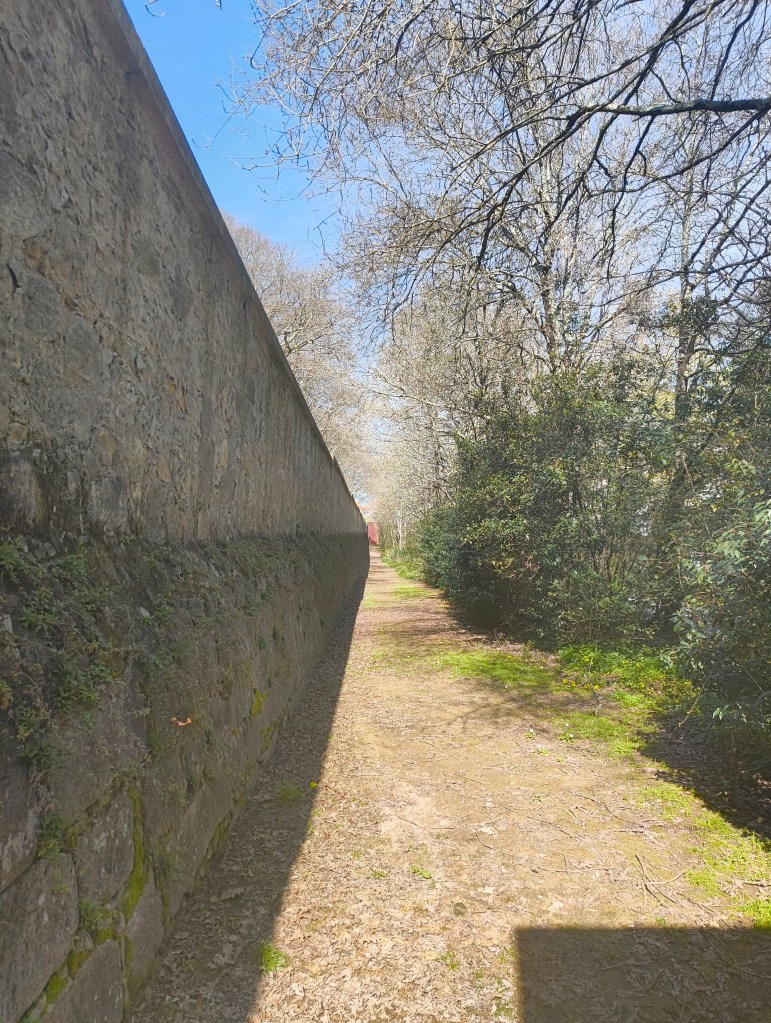
The final sculpture I encounter – out of order, according to the map – is Richard Serra’s Walking is Measuring. This is a site specific artwork, blocking off an old alleyway. Unused space beside the main building and a perimeter wall. Small, by Serra’s usual standard, this artwork still towers above me. Two monoliths mark the beginning and end of a passage. It is a good re-purposing of discarded space, and the angle I approach it allows me an odd journey back to the entrance of the foundation. By placing the steel panels far apart, the intervening space becomes conceptualised as part of the sculpture itself. An interesting exploration of viewer, location, and artwork.
In my exploration, I managed to miss a number of sculptures, but nevertheless had a pleasant and engaging time. Evidently the weather helped, but the quality and scale of the artworks transformed the gardens, offering an experience quite different than the typical exploration of stately manor grounds. I found myself paying better attention to my surroundings, and questioning the boundaries unsettled by the presentation of art in an already aestheticised space, leading to one of my favourite photographs of the trip – the small, unused faucet.

 Caleb
Caleb 
Leave a comment