Auto dos Anfitriões [The Act of the The Hosts] presents works from the Fundação Leal Rios Collection. It is disorienting, engrossing, and truly uncanny – in an unheimlich sense of the word. While exploring I could feel my heart rate increase, until I found myself attempting to power walk out of the building, only to get more lost. If the purpose of curation is to illicit an emotional response through the use of artworks, then this exhibition is a radical success.
I have just come in from a beautiful sunny romp around the sculpture garden. The inside of the Serralves Foundation is a cool respite. After entering the galleries-proper, I make the mistake of passing the threshold into Cinthia Marcelle’s começo, meio, começo, instilling a palpable sense of dread and setting the tone for my remaining exploration. Making my way over a connecting skybridge, I begin to get lost in the grand, clinical, modernist interior.
It is deep within the bowels of the Serralves Foundation that I discover The Acts of The Hosts. Already partially disoriented, I am in the perfect mindset with which to experience a range of uncanny installations, each – in their own way – breaking down the performance of being-in-space. Questions of interiority, of how we interact with and consider the space in which we inhabit, emerge.
The title of the exhibition comes from a 16th century play, inspired by a 3rd BCE play. To me, it sets up a scenario in which we are a guest in an absent host’s space. We see signs of the host, but never meet them, becoming a stranger within the white walls. The absence of the host – their echo, or ghost – is a key supporting character in this exhibition. Even in moments where I stood out of the sight-line of both attendants and fellow visitors, I felt watched, observed.
From the booklet, I learn that this is perhaps the only way to present this collection, as certain artworks require museum conditions to exist. Their scale undermines any domestic hallmarks. A wooden frame, reminiscent of a half-constructed object from IKEA, takes up a vast space. Shelves stretch far beyond the dimensions of a house. In every placement, every angle, there is an element of the unheimlich – the uncanny as understood as un-homely. Unsettling, through subtle alterations of expectations within the home.
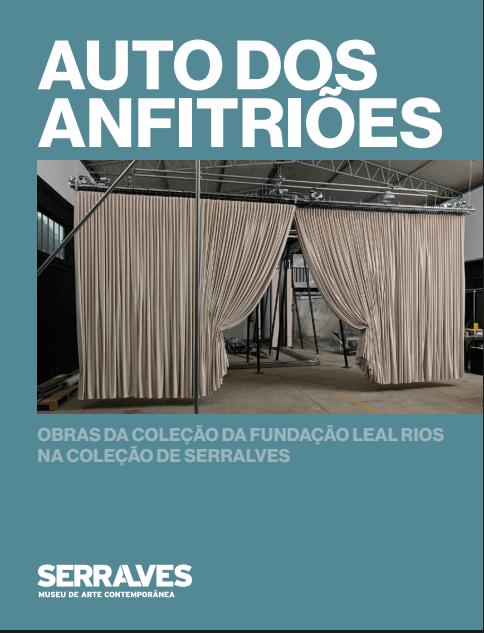
If the unheimlich is one of this exhibitions cores, it’s second is in ways of seeing. The first artwork encountered is a vast curtain, pulled by invisible motors to part – as if lifted by an invisible hand – allowing a small glimpse of the room behind. It’s motion, clinical and rhythmic, upsets the expected human action of parting a curtain by hand. We are invited to see beyond the artwork, but it does not care for our observation. It doesn’t react to human presence, rather unveils space on its own accord.
This is Ines Botelho’s Untitled, 2003-25. From the date, I can only assume the artwork to be an ongoing performance. Each motion building on the last. As for why it ended in 2025, I am not sure. Perhaps the information has not yet been updated. However, this curtain pointedly sets the stage of the exhibition. It reinforced our presence here as merely an actor within this fabricated echo of domesticity.
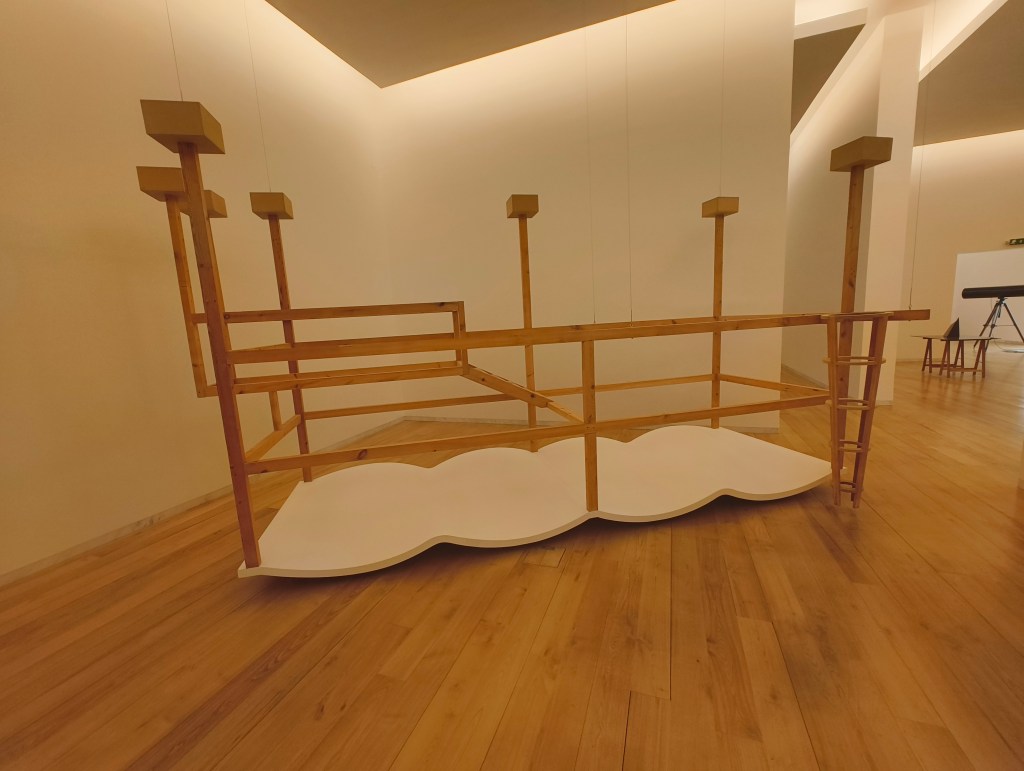
The wooden contraption I referred to earlier, is the skeleton of a house, suspended from the ceiling. An interposition of the house within the home, yet, at the same time, an inversion. We cannot access this secondary interior without risk of snapping the ties that bind it, so must leave it floating.
Perhaps the most disturbing, yet intriguing artwork is Susana Mendes Silva’s Rectangle Disorder. At first glance, I believe myself looking into an empty room. It is only through wondering why a room would be left bare that I see a single thread of hair dangling right in front of my face, uncomfortably close. Adjusting to the size of the fine material, I discover that the entire room is strung with synthetic hair, composing a grid set above head-height, the occasional strand reaching down to brush the visitor. Another echo of an absent host. I could not capture this room on camera – so fine were the threads. Here, a tension emerges between the organic and inorganic. Synthetic material bridges the gap between an embodied viewer and the surrounding architecture. We find the boundary between ourselves and the walls in which we stand dangerously thin.
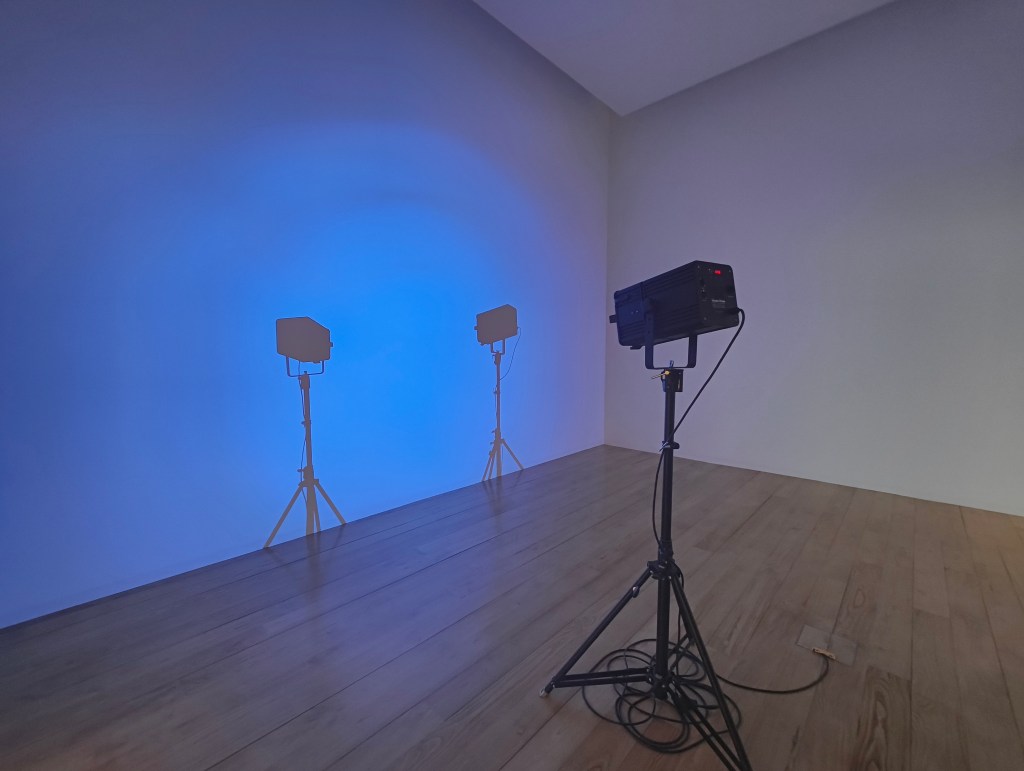
Another boundary, and another engagement with perception, is found in the next room. A stage light is pointed at a wall. On the wall, however, it casts its own shadow, impossibly. A simple trick. Most of the wall is coated with UV reactive paint. Yet, silhouettes of the light are left unpainted. Un-reactive, they read as shadows, cast from a non-existent light source. This is F is for Fake by Christian Andersson. In another context it might appear gimmicky. Here, it contributes to the overarching themes at play within this exhibited collection in a potent way.
Heard throughout the gallery is the sound of whistling. At first I mistake it for a fellow visitor. Of course, it is not. The loop is short enough that I notice it repeating. Around the corner, an oversized tape player, from which the sound emanates. It sits on colourful blocks. Rui Toscano’s Whistling in the Dark [Assiobiar no Escuro], 2001.
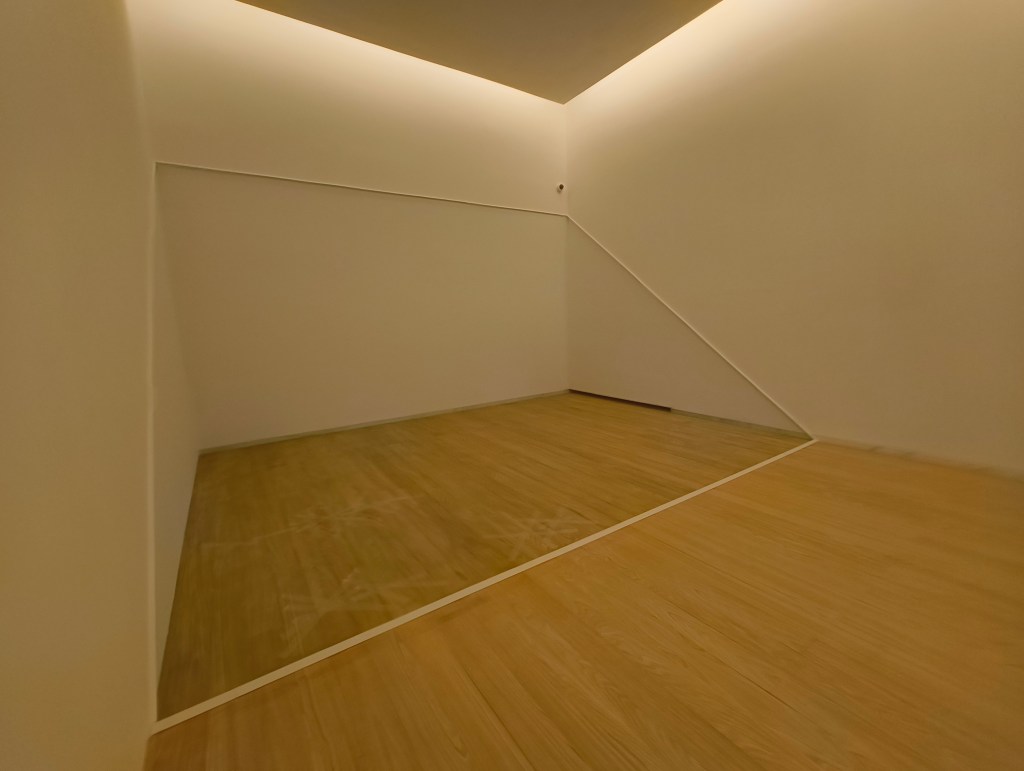
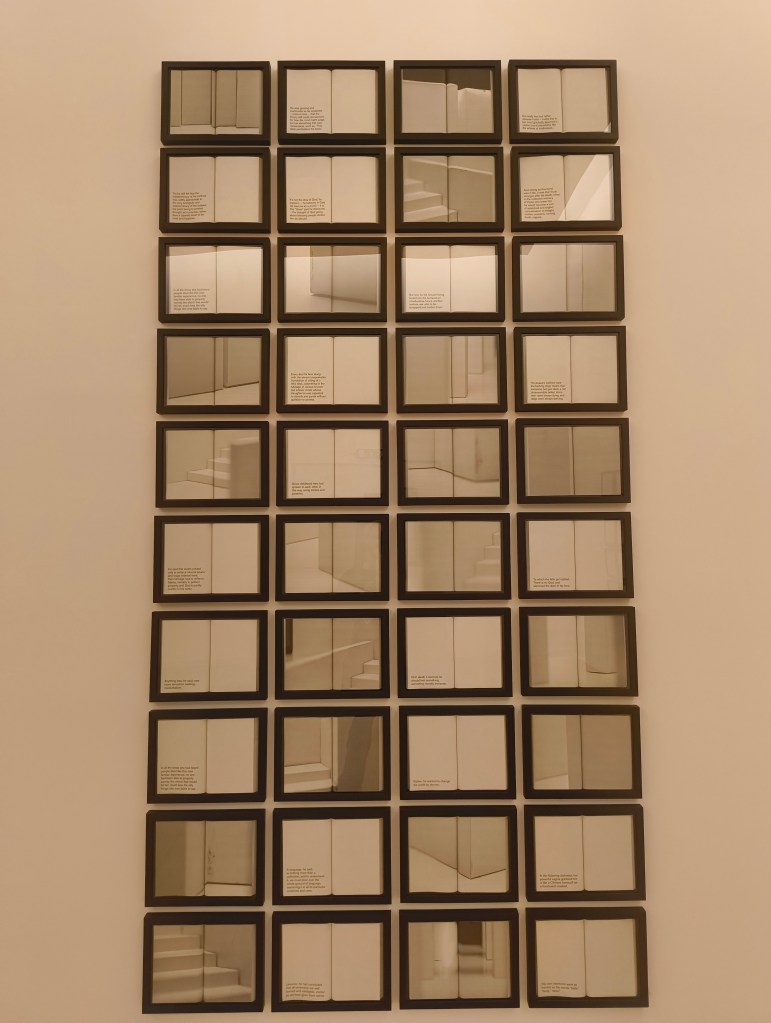
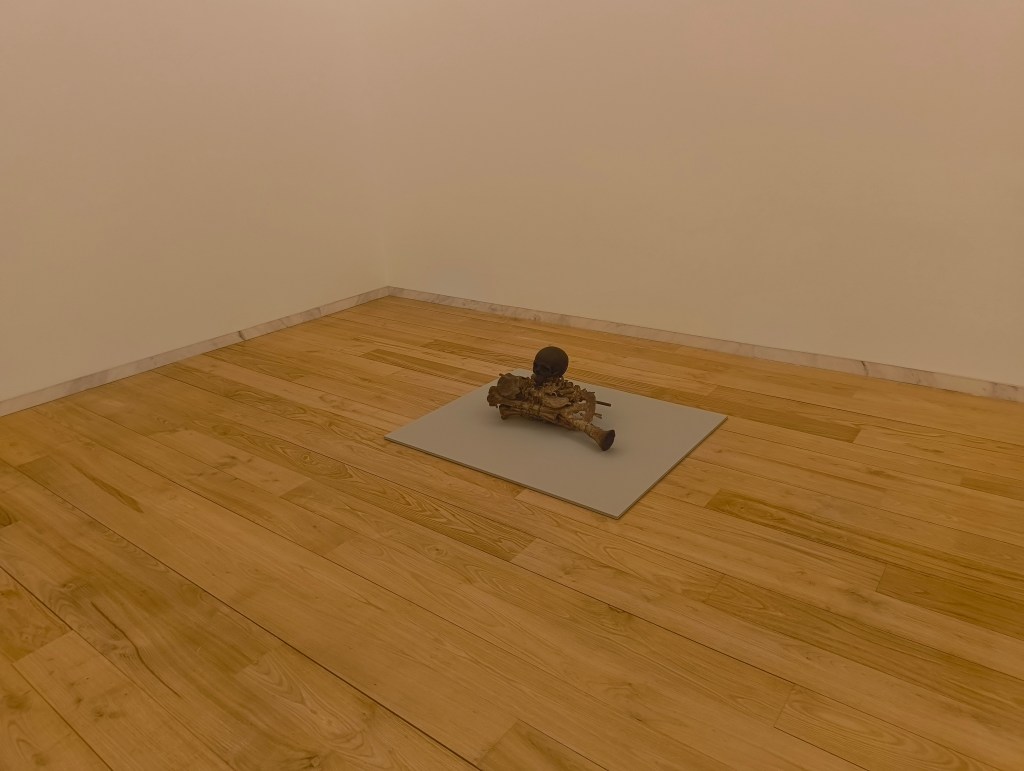
There are plenty more artworks within this space, however, in my growing discomfort and ever increasing sense of being watched, I neglected to take detailed notes, nor photographs. One room simply has a large sheet of glass, mounted diagonally, bisecting the room in an unintuitive angle. A bronze cast of a dismantled skeleton, skull sat on top, sits in the middle of the floor of another space. A memento mori. A disinterred grave. Books, each trapped within their own individual frames, alternate between vivid poetry and geometric, architectural forms. Even the stairwells seem sinister.
I make my escape, small glimpses of the beautiful garden outside now taunting me. My wish is to feel the sun on my skin, to walk no longer these barren hallways interspersed with challenges, reverberations of some arcane curatorial decision. It’s pretty spectacular.
Again, art need not always be provocative, but personally, if I find myself provoked – let alone unnerved and uncomfortable – then it’s probably doing something right.
The Act of the Hosts is on display at the Serralves Institute until June 28, 2026.

 Caleb
Caleb 
Leave a comment