So, how do we Un-Map?
Well, before we begin, this project is subjectivist, socially constructivist, and interpretivist. By all that, I mean that I seek to offer a toolkit – not an answer. I can never make concrete claims about what we can and should find through Un-Mapping. Instead, I can give you suggestions for how to un-map.
Again, before we begin, we are talking about shared symbols and history. The process of Un-Mapping will be unique for every pairing of map and reader. I, White-British, am equipped with a specific set of reference points. My findings will unavoidably reflect this.
The Map is self-referential. The more maps you have encountered, the more equipped you will be to read another. Having a shared language between the reader and the map, however, is not vital for Un-Mapping. In fact, someone with no shared language might be better posed to ask important questions – questions I might not even think to ask.
So, just to make clear – Un-Mapping and Re-Mapping don’t seek to generate a new understanding of space. Instead I hope to provide an opportunity to generate new understandings.
Right – that aside – how do we Un-Map?
Un-Mapping: The Process
Well, if a map engages in two levels of encoding, we will engage in two levels of decoding. If a map transforms a territorial conjecture into a cartographic representation, we will start at the cartographic representation, and work backwards to see if we can illuminate a possible territorial conjecture.
A map takes space, names it, turns it into an icon, and puts it on a map. So lets look at our map and start with an icon.
Decoding the Icon
When I say Icon, I’m not just talking pictographic. Through my research, I found that blocks of colour, numbers and words, and distances between icons were also valuable points to start our analysis.
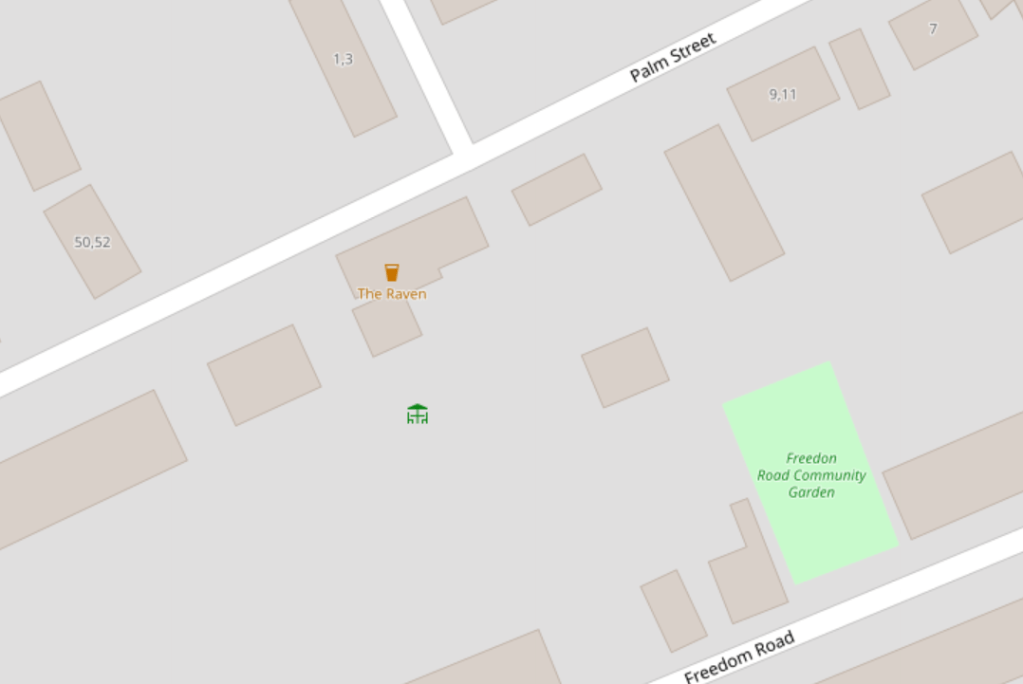
So let’s take an icon. Sticking with our example of “The Raven” pub, we have our brown pint glass. It is a simple pictograph, showing a trapezoid shape, mostly filled, but with a bit of space. Because of my pre-existing knowledge and engagement with similar maps, I recognise this as a shared symbol for a pint-glass.
Let’s look at how it is encoded. There are three questions to ask ourselves at this level.
How is it encoded Pragmatically? – What Action Does It Suggest?
Well, here, it suggests consumption of liquid. We are presented a pint-glass, after all. It suggests a good or a service that we can access. Quenching thirst.
How is it encoded Semantically? – What Images/Symbols/Meanings does it evoke?
Firstly, alcohol. Beer – or cider, I suppose. However, there are deeper semantic connections. A drink after a hard day at work. A trip to the pub with mates. Any meanings generated by this step of decoding will come from the interaction between the Un-Mapper and the icon. You might connect it with a specific time, event, or similar place.
How is encoded Syntactically? – Is there anything important about where it is on the map?
Well, upon closer inspection we see it is near an icon that looks like a picnic bench. It is off from the main string of icons up on the main road. It is surrounded by houses, and seems to be the only icon of its kind on this exact road. More pertinently, by being located here, it encodes the fact that all of the pragmatic and semantic observations we have just made are localised precisely here. The act of getting a pint is localised to the position of this pint-glass icon.
Ok, some observations, nothing that surprising at this point. However, we can begin to see that interacting with the pint-glass icon gives us a lot more context – and a lot more expectations – than perhaps first thought. If we were to visit the location of this icon, we would have a preconceived notion of what we would encounter.
So, we’ve done our first level of decoding – onto our next: Designation.
Decoding the Designator
There’s a couple shortcuts we can take here to identify any relevant names attached to this icon. Firstly, it is labelled on the map. Secondly, the icon has a corresponding designator attached to it in the key. If there is no obvious designator attached to your icon, it is up to you to make an educated assumption as to what the name of your icon could be. Depending on what you pick, you might find different observations. Again, we are not looking to create the correct understanding of space, but to spend time thinking about new understandings of space.
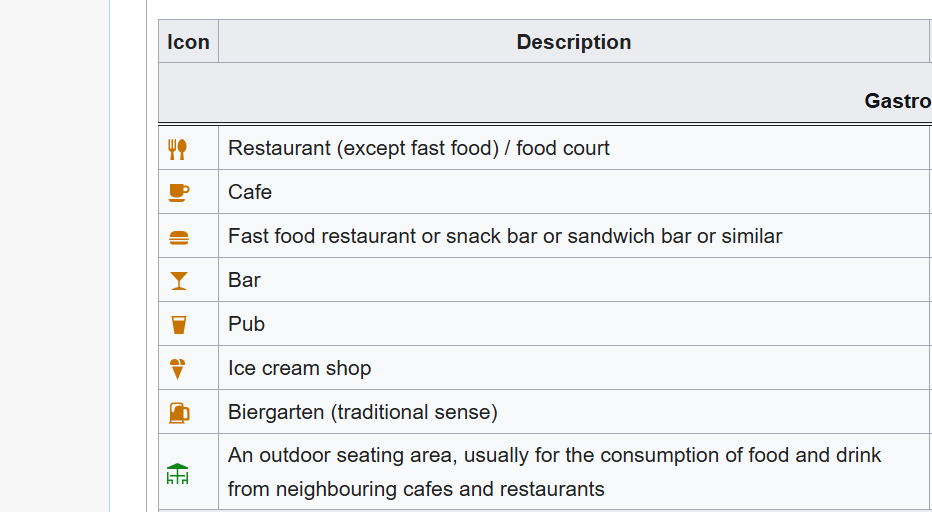
So, here, we have our designators. “The Raven” – as seen on the map proper – and “pub” – as seen on the map legend.
Here, there are two questions we should ask ourselves. What does this word Denote – what does it literally mean. And what does it Connote – what does it suggest?
Well, the designator “The Raven” doesn’t help us much in the way of denotation. It literally refers to the bird. “Pub”, however, literally means public house, a place where the public can come and purchase alcohol and – on occasion – food and board.
But what do they connote? Well, “The Raven” connotes a sort of Gothic Atmosphere. It’s links with Edgar Allan Poe suggest a literary angle. It is not a very common name for a pub, so suggests trying something different, perhaps? And “Pub” connotes a place for spending time with others. For me it suggests boardgames after a rainy walk. Card games with old friends. After work drinks.
So, we’ve generated a set of observations, at both the level of icon and designator. At both levels, extraneous information is stripped away. Our next question is to see if we can note any details that the icon removes from the designator. Here, we have a shortcut, because our pint-glass doesn’t contain any information about the black bird, or gothic connotations of the designator The Raven.
Uncovering a Potential Territorial Conjecture
Our next step is to, using our observations, think about what the map is telling us through the icon? What is the territorial conjecture?
Here, the conjecture might be that this building is a place to buy alcohol. This might seem self evident – and it is through the map – but it is merely a suggestion as to how the space should be considered. However, by encountering this suggestion passed through the two layers of naming and iconising, the map reader is presented with a statement. Here is a pub. And a set of connotations.
So what does this territorial conjecture tell us about the map as a whole? Well, if we were to apply a level of critique, we could claim that the icon platforms the consumption of alcohol as a self evident truth about this location, thus contributes to the normalisation of alcohol consumption in shared social space.
Of course, this is a specific example, but I hope it proves a point.
The process of Un-Mapping aims to look not at what a map tells us is there, but rather to look deeper to think about what the map suggests about space and about how we should use the space.
So, to recap. Our process of Un-Mapping is as follows.
Identify an icon. Consider how it is encoded pragmatically, semantically, and syntactically. Then, Identify any designators. Consider what the designator denotes and connotes. With these observations, consider any underlying territorial conjectures. Think about what the map conveys as truth, and why this might not be the only reality.
Next Steps
From here, there are two directions you can take. You can visit the results of my Un-Mapping of a handful of Museum Maps, to get some inspiration for how this process might generate new ideas about museum and gallery spaces. Or, you can get creative and join me in Re-Mapping. It’s time to consider what we understand about space and how we can re-construct, and re-produce space through the map.

 Caleb
Caleb 